Key Takeaways
- Collier County has roughly one golf hole for every 37 residents, a ratio no major metro in the country can match.
- The golf-real estate development model that built Naples turned courses into infrastructure, not amenities, developers needed them to sell land.
- Southwest Florida's retirement demographics, snowbird culture, and 12-month playing season compound the demand side in ways that Sun Belt competitors simply don't see at the same scale.
- A construction boom between roughly 1985 and 2007 added dozens of courses in a short window, locking in a density that hasn't unwound even as national course counts have dropped.
- Understanding why the concentration exists helps players and buyers make smarter decisions about where to live and play.
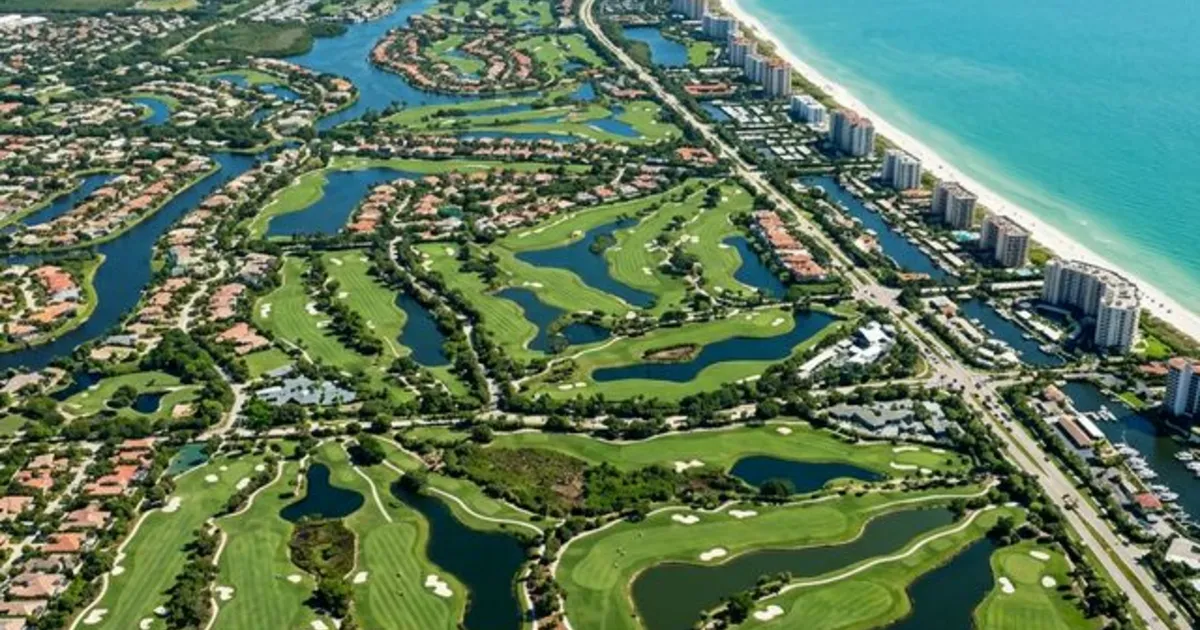
If you drive through Naples or Bonita Springs for the first time, you notice it almost immediately. The fairways are everywhere, behind the grocery store, flanking the highway interchange, tucked into gated communities that seem to materialize every half mile.
It doesn't feel like a coincidence, and it isn't.
Southwest Florida, specifically the corridor running from Charlotte County through Lee and Collier Counties, has a higher concentration of golf courses per capita than anywhere else in the United States. That's not regional boosterism.
It's a measurable fact rooted in a specific set of economic, demographic, and geographic forces that came together in a narrow window of time and produced something that's genuinely hard to replicate elsewhere.
Here's the full picture.
The Numbers Behind the Claim
The National Golf Foundation tracks course supply and demand across the country. At the national level, the U.S. averages roughly one 18-hole equivalent course per 25,000 residents.
That's already a high ratio by global standards, but it masks extreme regional variation.
Collier County, home to Naples, tells a different story. The county has well over 90 golf courses serving a permanent resident population of around 380,000.
When you convert that to 18-hole equivalents and run the per-capita math, you get somewhere in the range of one golf hole for every 35 to 40 permanent residents. Even using conservative estimates, that's roughly 15 to 20 times the national average density.
Lee County, which includes Fort Myers, Cape Coral, Bonita Springs, and Estero, adds another 130-plus courses on top of that. Combined, the two-county region holds more golf infrastructure per square mile, and per person, than any comparable geography in the country.
For context: Myrtle Beach, which markets itself as Golf Capital of the World, has roughly 90 courses for a region of about 500,000 people during peak season. Scottsdale and the Phoenix metro area have a higher absolute count but spread it across a much larger population base.
The Pinehurst region of North Carolina has density in a small footprint but doesn't scale the same way across a two-county residential population. Southwest Florida wins on the per-capita math almost regardless of how you draw the boundaries.
The Real Estate Model That Built It All
Golf courses in Southwest Florida weren't built primarily because people wanted to play golf. They were built because developers needed to sell land.
Starting in the 1960s and accelerating sharply through the 1970s and 1980s, Florida's development model, particularly in Collier County, centered on a simple formula: buy swampland cheaply, drain it, build a golf course, and then sell the lots surrounding the fairways at a significant premium. The golf course wasn't the product.
The golf course was the sales mechanism.
Developers like the Collier family and later large national homebuilders understood that a golf course transformed raw subtropical land into something aspirational. A lot on the 14th fairway of a private club could command three to five times the price of an identical lot without the view.
The course paid for itself many times over in land sales, even before membership dues entered the picture.
Communities like Grey Oaks in Naples and TPC Treviso Bay reflect this model at different points in its evolution, Grey Oaks as a member-equity private club built around three courses to anchor a luxury residential development, TPC Treviso Bay as a later iteration that brought Tour-level branding to the same underlying logic. The course draws buyers.
"Always a pleasure playing at TPC Treviso. Nice layout and challenging holes with fast greens."
napolidon2012, GolfPass review
The buyers fund the course. The surrounding real estate captures the premium.
This model required a continuous pipeline of new communities, which meant a continuous pipeline of new courses. That feedback loop is why the density exists.
Demographics: Who Actually Lives Here
Supply alone doesn't explain why these courses stayed open and kept growing. Demand had to match it, and Southwest Florida has demand that few places can replicate.
The median age in Collier County is around 52, one of the highest county medians in the country. Roughly 30 percent of the permanent population is 65 or older, according to U.S.
Resident and seasonal demand supports a broad private-club market. Membership costs must be obtained from each club rather than inferred from census data.
The membership base for private clubs here is about as deep as it gets anywhere in the country.
Layered on top of the permanent residents is the snowbird population, seasonal residents who arrive from October through April and inflate the effective population of the region by a substantial margin. Estimates vary, but during peak season, the Naples area may effectively double in population.
That means every golf course in the area is trying to serve roughly twice as many golfers during the five to six months when everyone wants to play.
The result is that Southwest Florida needed to build enough course capacity not for its year-round residents, but for the crush of seasonal demand. That's a very different planning equation than most markets face, and it pushed total course count higher than permanent population alone would justify.
You can read more about the private membership landscape in Naples to understand just how structured that demand has become.
Climate as Infrastructure
Southwest Florida gets about 264 days of sunshine per year. Rainfall is heavy but concentrated, the wet season runs June through September, and even then, afternoon storms typically clear within a few hours, leaving the course playable the same day.
The temperature rarely drops below 50 degrees Fahrenheit, and frost is essentially unknown.
What that means practically is that a golf course here can operate 365 days a year. Not just theoretically, actually.
A course in Minnesota or Michigan might see 150 to 180 playable days on a good year. A course in Scottsdale can approach 300, but summer heat regularly pushes daily rounds to early morning tee times only.
Southwest Florida is genuinely all-weather, all-day, all-year.
That changes the economics of course ownership significantly. A higher annual round count means more revenue against largely fixed infrastructure costs.
That makes building courses more financially viable here than in most of the country, which contributed to the pace of development during the boom years.
Operating daily-fee courses can change prices with season and demand. Compare dated quotes rather than using Old Corkscrew, whose daily operations have ended, as a current example.
The Construction Boom and Why It Happened When It Did
The density you see today is largely the product of a 20-year construction window that ran from roughly 1985 to 2007. Golf Digest has tracked the national course opening and closing trends, and the pattern is clear: the U.S. added courses at a remarkable pace during that stretch, and Southwest Florida participated at a rate several multiples above the national average.
Several factors converged during that specific window. The Baby Boom generation was moving into its peak earning and retirement years through the late 1980s and 1990s, and Florida had already established itself as the primary destination for northeastern and midwestern retirees.
The combination of Interstate 75's completion through Southwest Florida (I-75 reached Naples in 1986) and the growth of Southwest Florida International Airport made the region dramatically more accessible.
Land was still relatively affordable through the 1980s and early 1990s, which meant developers could acquire the acreage necessary for golf community development before prices climbed. By the time the 2000s real estate boom hit full stride, the fundamental land-golf-real estate model was already embedded in the regional economy and continued running on momentum until the 2008 financial crisis stopped it cold.
The aftermath of 2008 was significant. Nationally, the golf industry has closed more courses than it has opened every year since approximately 2006.
Southwest Florida saw some of the same pressure, a handful of courses converted to other uses or went dormant during the downturn. What's notable is how many survived.
The demographic base here was strong enough to support membership and green fee revenue even through a severe recession, which tells you something about the structural demand.
The full history of golf in Naples covers the earlier chapters of this story, including the pioneering courses that established the template before the boom.
How Southwest Florida Compares to Other Golf Markets
It's worth putting Southwest Florida in direct comparison with the markets it's most frequently measured against.
Myrtle Beach, South Carolina has roughly 90 courses and markets itself aggressively as a golf destination. Its model is tourism-first, the courses exist to attract visitors, not to serve a residential real estate ecosystem. The per-capita numbers look strong only if you count seasonal visitors as population, and even then, Collier and Lee Counties together outpace it.
Scottsdale/Phoenix has more total courses, somewhere over 200 in the broader metro area, but those 200 courses serve a metro population of 5 million. The density on a per-resident basis isn't in the same conversation as Southwest Florida. The courses are also somewhat constrained by summer heat, which compresses the effective demand period.
Palm Beach and the broader South Florida corridor has significant golf infrastructure, but the land economics are different. Density and development pressure in Miami-Dade, Broward, and Palm Beach Counties have converted many former golf properties to other uses over the past two decades. Southwest Florida, with its lower land costs and continued growth in adjacent residential development, hasn't faced the same conversion pressure at the same scale.
Hilton Head and the Lowcountry of South Carolina presents a similar model, golf-centric real estate development with a strong retiree base, but operates at a fraction of the scale. Beaufort County has roughly 35 courses for a population of around 190,000. The density is meaningful, but still well below what Collier County alone achieves.
Southwest Florida's combination of scale, density, residential integration, year-round climate, and demographic depth creates something that doesn't have a real peer in the American market.
What This Means for Players and Buyers
For golfers visiting the area, the concentration of courses means genuine choice at every price point and access level. The Naples visitor golf and access guide range from championship-level daily fee venues to more accessible tracks, all within a short drive of each other.
For buyers considering a move to the area, the golf course real estate model cuts both ways. Living on a fairway carries real value, aesthetic, lifestyle, and resale, but it also means your property value is partially tied to the financial health of the course you're adjacent to.
Courses in Southwest Florida have generally been more stable than the national average because of the demand fundamentals, but it's worth doing homework on any specific club's financial structure before committing to a golf community purchase.
The density also creates genuine competition between clubs for members and between courses for rounds. That competition has kept course quality high and pushed clubs to invest in improvements in ways that markets with less supply pressure don't require.
The golfer benefits from this even if the club accountants don't always love it.
The Concentration Isn't an Accident
Southwest Florida didn't end up with more golf courses per capita than anywhere else in the country through luck or geography alone. It's the product of a deliberate development model, a specific demographic moment, a climate that makes year-round play economically viable, and a 20-year construction window that happened to align with all three.
The result is a region where golf isn't an amenity that's been added to a community, it's structural. The courses and the communities grew up together, and that integration is what makes the Southwest Florida golf market genuinely different from every other market in the country.
Frequently Asked Questions
How many golf courses are in Southwest Florida?
The exact count depends on how you define the region, but Collier and Lee Counties together have over 200 golf courses, including both private and public facilities. Collier County alone has more than 90 courses, giving it one of the highest course-to-resident ratios in the country.
Why does Naples have so many private golf clubs?
Naples developed primarily as a high-income retirement and second-home market, which created a large base of residents with both the time and financial means to support private club membership. The golf-real estate development model also created a structural need for private courses, developers built them to sell lots, and the resulting communities have sustained them as member-equity or developer-owned clubs for decades.
Is Southwest Florida a good place for a golf vacation?
Yes, particularly from November through April. The concentration of courses at different price points, the year-round playing conditions, and the overall quality of both private and public facilities make it one of the stronger golf destination markets in the country.
Peak season brings higher green fees and tighter tee times, so booking in advance is worth the effort.
Are there affordable public golf courses in Southwest Florida?
Absolutely. While the private club scene gets most of the attention, the region has a solid range of public and semi-private options that are accessible without membership. Green fees at public tracks vary widely by season, with summer rates often significantly lower than peak winter pricing.
Has the number of golf courses in Southwest Florida declined like the rest of the country?
The region has seen some attrition, a small number of courses closed or converted after the 2008 financial crisis, but the overall course count has held up significantly better than the national trend. The demographic demand from retirees and snowbirds has provided a more stable membership and rounds base than most markets, which has protected the course supply from the sharper declines seen in other parts of the country.
What time of year has the most golf activity in Southwest Florida?
January through March is peak season, tee sheets at desirable courses fill up quickly, green fees are at their highest, and the roads around golf communities are noticeably busier. October and November offer a good middle ground: weather is excellent, snowbirds are beginning to arrive, but the full rush hasn't hit yet.
Summer is the quiet season, with lower prices and more availability, though afternoon thunderstorms are a daily reality from June through September.
auto_stories Recommended Reading