Key Takeaways
- Southwest Florida courses, especially private and resort tracks, move at a brisk pace year-round, and slow play is the quickest way to wear out your welcome.
- Most clubs enforce a collared shirt and soft-spike policy; a handful of top-tier courses add specific trouser and footwear requirements.
- Cart rules vary by club and by weather, always confirm before you assume you can drive cart-path-only or take the fairway route.
- Divot repair and bunker raking are non-negotiable here, not optional courtesies.
- Cell phone etiquette is taken seriously, SWFL's affluent member base has zero patience for ringing phones on the course.
- Tipping caddies, bag staff, and beverage cart attendants is an unspoken expectation at every facility outside the municipal level.
Southwest Florida is one of the most golf-saturated regions in the country. Between the resort tracks in Naples, the public courses spread across Fort Myers and Cape Coral, and the private clubs that cater to seasonal residents with high expectations, the etiquette standards you encounter here can differ significantly from what you are used to back home.
Some of these rules are written down. A lot of them are not.
This guide covers both, with particular attention to the unwritten ones that can quietly get you labeled as "that group" by the time you reach the turn.
Pace of Play: The Number One Priority on Every SWFL Course
If there is one thing Southwest Florida golfers take personally, it is slow play. The region attracts serious players, retirees who play four or five times a week, snowbirds who came here specifically to golf, and resort guests who paid premium green fees and expect a smooth round.
Most 18-hole rounds at resort and private courses here are expected to finish in four hours or less. Some private clubs shoot for three hours and forty-five minutes.
The USGA Rules of Golf state that a player should make a stroke in no more than 40 seconds once it is their turn to play. That standard is the baseline, SWFL regulars often operate faster.
Ready golf is widely accepted and expected at most facilities here, including at prestigious tracks like TPC Treviso Bay and Tiburon Golf Club.
"Always a pleasure playing at TPC Treviso. Nice layout and challenging holes with fast greens."
napolidon2012, GolfPass review
Practical tips to stay on pace:
- Be at the tee box and ready when it is your group's time, not walking from the cart.
- Plan your shot while others are hitting, not after you step up.
- If you are searching for a lost ball, the USGA allows three minutes under current rules. Do not burn the full three if you can see the group behind you waiting.
- At busy public courses like Eastwood Golf Course in Fort Myers, rangers do monitor pace, they will ask you to pick up the pace or skip a hole if your group falls behind.
Falling more than a full hole behind the group ahead is the threshold where a ranger will step in. The goal is keeping the whole course moving, not just your group's enjoyment.
"I had to check my receipt again because I couldn't believe I was playing such a fine course for the amount I paid. The layout was challenging, the fairways were excellent and the pace of play was comfortable."
jetsamjosi, GolfPass review
Dress Codes: What You Wear Matters More Than You Think
Southwest Florida's heat makes casual dress tempting, but most courses, public and private alike, maintain standards. The baseline across the region is a collared shirt, golf shorts or slacks, and soft-spike shoes.
Tank tops, cargo shorts, and athletic sneakers will get you turned away at the bag drop at most facilities without a conversation.
Resort courses tied to luxury hotels tend to add layers on top of that baseline. Some require that shorts reach at least mid-thigh.
A few prohibit denim entirely, even on the patio. Private clubs can be even more specific, certain clubs require trousers on the course during morning rounds or in the clubhouse dining room at all times.
The safest approach is to check the club's specific requirements before you show up. Our full breakdown of what to wear at SWFL's major facilities is covered in detail in the SWFL Golf Course Dress Codes guide.
The short version: dress as if you are playing somewhere slightly more formal than you expect, and you will rarely be wrong.
Cart Behavior: Rules That Change by Course and by Day
Golf cart rules in SWFL are not uniform, and that catches visitors off guard more than almost anything else. Some courses run cart-path-only year-round to protect their turf, this is common at high-end resort tracks after heavy rain or during active overseed periods in the fall.
Others operate a 90-degree rule, meaning you drive down the cart path and cut onto the fairway at a 90-degree angle to reach your ball. A few allow unrestricted fairway access during the right conditions.
Beyond the rules posted on the cart itself, there are unwritten expectations. Driving carts on the fringe and approaches is universally frowned upon, stay well back from greens, and never cross a green with your cart.
Do not park carts directly adjacent to tee boxes where they obstruct the view. When another player is hitting, stay out of their sightline and avoid rolling the cart behind them.
Speed also matters. SWFL courses can be crowded during season (November through April), and reckless cart driving is not just a courtesy issue, it can be a liability one.
The full rundown of cart rules specific to Southwest Florida facilities is in our golf cart rules and etiquette guide.
Divot Repair and Bunker Raking: Not Optional Here
Southwest Florida's subtropical climate means turf conditions are both exceptional and fragile. Courses invest heavily in their Bermuda and Paspalum fairways, and the staff notices, and remembers, groups that do not repair their divots.
At most courses here, you will find divot mix bottles on every cart. Use them.
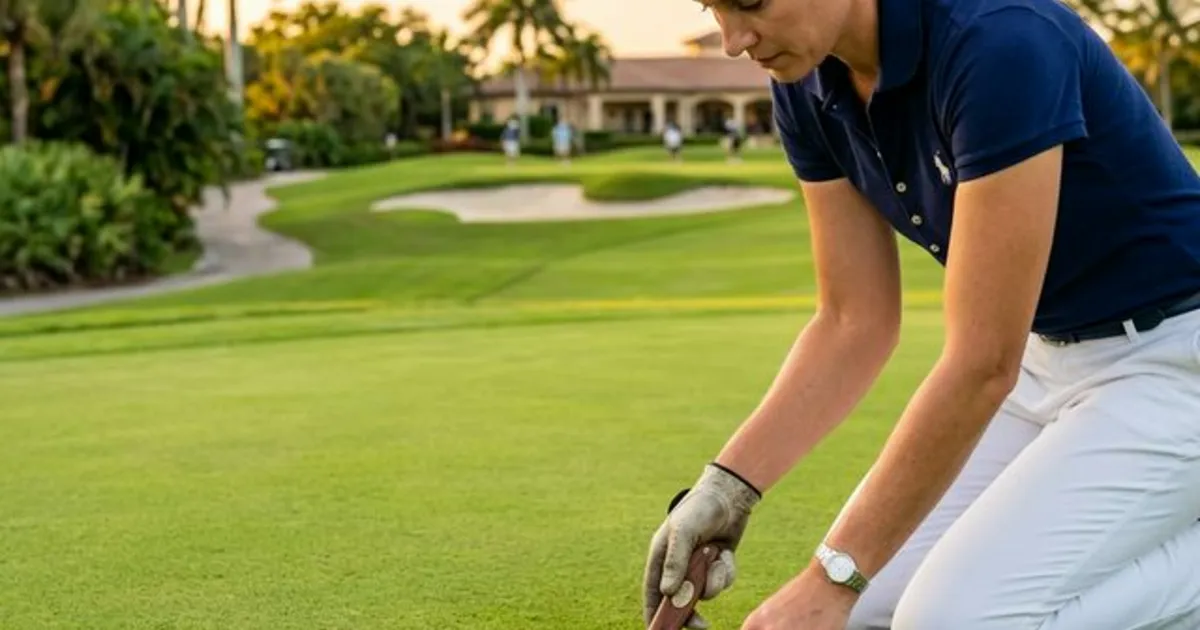
Fill your divot with the sand-and-seed mix, tamp it down, and move on. It takes five seconds.
Ball marks on greens are equally important. The USGA's recommended ball mark repair technique involves inserting a repair tool at the edge and pushing the turf inward rather than lifting, which avoids damaging the root system.
Fix your own mark and one more if you see one nearby, that is the standard SWFL regulars follow.
Bunkers require the same attention. Rake the sand after every shot, including the area where you walked in.
Most courses position rakes along the edges of bunkers, place them parallel to the fairway after use, either inside or outside the bunker depending on the club's preference (ask the pro shop if you are not sure). Leaving a churned-up bunker is one of the fastest ways to draw negative attention from locals and course staff.
Cell Phone Policies: Read the Room
There is no universal cell phone policy across SWFL courses, but the cultural expectation is consistent: your phone should be silent, and voice calls should be an exception rather than the norm. At private clubs, taking a long call on the course is widely considered disrespectful to other members and guests.
Some clubs explicitly prohibit audible phone use on the course and in the clubhouse grill.
Texting, using a GPS app, or checking a score is fine and nobody will blink. Speakerphone, streaming audio without earbuds, or taking a 10-minute business call on the 14th fairway will earn you looks from every group within earshot.
If you genuinely need to take a call, step away from other players, keep it brief, and rejoin your group quickly so you do not affect pace.
Photography for personal use is generally fine at most facilities, but always check at resort courses with signature design features, some restrict photography of certain holes for brand-related reasons.
Tipping: The Unspoken Expectation That Visitors Often Miss
Tipping in SWFL golf culture is not a suggestion, it is an expectation at nearly every facility above the basic municipal level. The people who handle your bags, clean your clubs, stage your cart, and keep the beverage cart stocked are working for wages that assume gratuities.
General guidelines that hold up across the region:
- Bag drop staff: $2 to $5 per bag when they load and unload your clubs.
- Caddies: 50% of the caddie fee is a reasonable baseline; more if the read was excellent or the round was long.
- Beverage cart: $1 to $2 per drink, or a lump sum at the end of the round if the cart came around frequently.
- Forecaddies (bag handlers who ride in a separate cart): $20 to $40 per player depending on the level of service.
Cash is still strongly preferred in all of these situations. Not every facility's staff can accept card tips through a terminal, and cash tips are far more reliable from the worker's perspective.
Carry small bills when you head out for a round, it is one of those SWFL habits that marks you as someone who understands how this environment works.
Local Customs Unique to Southwest Florida
A few things come up regularly in SWFL that you may not encounter to the same degree elsewhere.
Wildlife awareness. Gopher tortoises, sandhill cranes, alligators, and various wading birds are year-round residents on Southwest Florida courses. The unwritten rule is straightforward: give them space, do not feed them, and never move a tortoise or attempt to shoo a gator. If your ball lands near an alligator, you take a free drop, no local golfer is going to judge you for that. The USGA rule on dangerous animal situations supports exactly this kind of relief.
Weather windows. SWFL's lightning season runs from May through September, and afternoon storms move in fast. Courses take this seriously, air horns or sirens signal a mandatory suspension of play, and you are expected to clear the course immediately. No exceptions, no "just one more hole." Groups that ignore lightning suspensions face removal from the property. Most locals tee off early in summer to avoid the afternoon window entirely.
The season mentality. From roughly Thanksgiving through Easter, SWFL courses are at or near full capacity. Tee times book out weeks in advance, pace of play tightens up further, and staff expectations go up proportionally. If you are visiting during peak season, treat every round as if you are a guest at a busy private club, because in many cases, you effectively are.
Overseed season. Many courses in the region overseed with ryegrass in October or November to maintain green turf through the cooler months. During and immediately after overseed, you may encounter cart restrictions, modified tee assignments, or temporary greens. This is not a complaint-worthy inconvenience, it is part of the regional golf calendar, and locals know to plan around it.

Frequently Asked Questions
Do all Southwest Florida golf courses require soft spikes?
The overwhelming majority do, yes. Metal spikes have been phased out at virtually every facility in the region.
A few older municipal courses have not formally updated their posted policy, but soft spikes are the safe assumption everywhere. If you are renting shoes from a pro shop, they will already be soft-spike equipped.
Is ready golf standard in SWFL, or do some courses still play strict honor rules?
Ready golf is accepted and encouraged at most courses in the region during casual and resort rounds. Strict honor, playing in order of furthest from the hole, is generally reserved for competitive events or when players specifically agree to it.
If you are in a group that wants to play honor rules, just say so at the first tee, but expect most locals to default to ready golf without asking.
What is the general rule on cell phones at private clubs in Naples?
At most Naples-area private clubs, the expectation is that your phone is silent during play and that voice calls are taken briefly, away from other players. Many clubhouses extend this to the dining areas, check posted signage.
If you are a guest of a member, follow the member's lead on what the specific club considers acceptable.
Are there specific rules about alligators during a round?
Yes, if your ball comes to rest near an alligator or other dangerous animal, you are entitled to take free relief under the USGA's rules on dangerous situations. Drop as close to where the ball lay as possible, no closer to the hole, within one club length.
Never attempt to retrieve a ball that is within striking distance of an alligator. No shot is worth it, and no local golfer will question your decision to drop away.
How much should I tip the bag staff at a resort course?
At a resort course in Naples or Bonita Springs, $5 per bag on both ends, when they stage your clubs and when they clean them after the round, is a solid and appreciated standard. If your clubs needed significant work or the staff went out of their way to accommodate you, tip accordingly.
Carry cash; most bag staff cannot process card tips on the spot.
What happens if a lightning warning sounds mid-round?
Clear the course immediately. Most SWFL courses use an air horn or siren system, one long blast typically signals a suspension, and three short blasts signal an all-clear to resume.
Head to the nearest shelter structure, which will be marked on your course map. Do not wait under trees.
Courses will typically hold your tee time and allow you to resume from where you stopped once conditions are safe.
auto_stories Recommended Reading