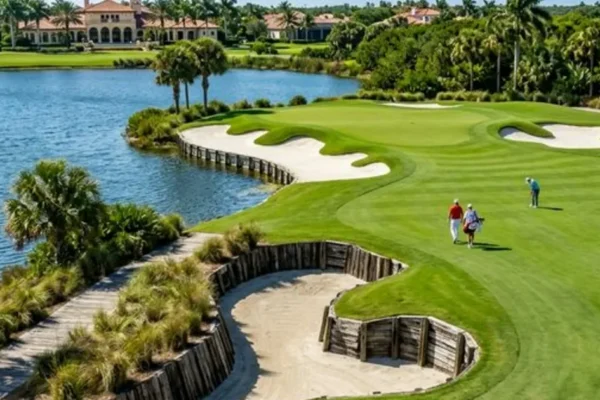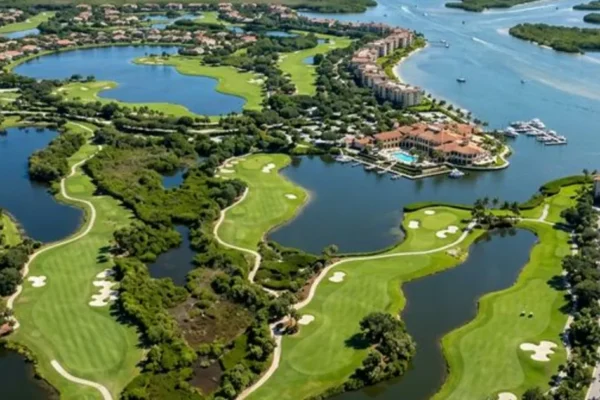
Key Takeaways
- Audubon Cooperative Sanctuary certification is a rigorous, third-party verified program, not a marketing label.
- Certified courses must meet measurable standards for environmental planning, water quality, chemical use, habitat management, and wildlife stewardship.
- Southwest Florida courses holding the certification include Audubon Country Club, Bonita Bay Club, Old Corkscrew Golf Club, and TPC Treviso Bay.
- SWFL's subtropical ecosystem makes it one of the most ecologically significant places in the country to get this right, and certified courses do far more than post "we care about the environment" on their website.
- If you value playing on land that is actively managed as a functioning habitat, these courses are worth your attention.
Most golf courses in Southwest Florida will tell you they take the environment seriously. A handful of them can actually prove it.
The Audubon Cooperative Sanctuary Program for Golf, run by Audubon International and not affiliated with the National Audubon Society, is the golf industry's most well-established independent certification for environmental performance. Getting it is not a formality.
Maintaining it is harder still. The courses in SWFL that have earned and kept this designation are worth understanding, because what they are doing on the ground matters in a region where the ecological stakes are genuinely high.
What Audubon Cooperative Sanctuary Certification Actually Means
The Audubon Cooperative Sanctuary Program for Golf was established in 1991 in partnership with the United States Golf Association. Since then, more than 900 courses worldwide have earned certification.
The number sounds large until you compare it to the roughly 16,000 golf courses operating in the United States, certification represents a small percentage of the total.
To earn the designation, a course must demonstrate verified performance across six core categories: environmental planning, wildlife and habitat management, outreach and education, chemical use reduction and safety, water conservation, and water quality management. Each category requires documentation, measurable outcomes, and third-party review.
A course cannot simply declare that it has good intentions, it has to submit records, management plans, and evidence of on-the-ground practices for independent evaluation.
The distinction between certified and "working toward certification" matters. Audubon International runs an enrollment program that lets courses document practices before formal certification is granted, some have been enrolled for years without completing the process.
When a course claims Audubon certification, that claim is verifiable against the public registry. Recertification is required periodically, and standards have been updated over time, so current certification reflects active, ongoing management, not a credential earned a decade ago and left on the shelf.
Which Southwest Florida Courses Hold the Certification
Southwest Florida has a concentration of Audubon-certified courses that reflects both the quality of the facilities here and the pressure that comes from operating in one of the ecologically richest regions in the country. The courses below hold or have held Audubon Cooperative Sanctuary certification, and each approaches environmental management in ways that make the credential meaningful rather than decorative.
Audubon Country Club in Naples takes its name from the program itself, which is a level of institutional commitment that goes beyond marketing. The club has built its identity around environmental stewardship, and the course is designed around the preserve corridors and wetlands that define the southwest Naples landscape.
The certification here is not incidental, it is core to what the club is.
Bonita Bay Club operates multiple courses within a master-planned community that has long prioritized conservation land. The club's management of its natural areas, native plantings, preserve buffers, wetland systems, reflects investment at a level that sustains certification across the board, not just on one course.
Bonita Bay has consistently been cited as one of the stronger environmental performers in Southwest Florida golf.
Old Corkscrew Golf Club in Estero sits on land adjacent to Corkscrew Swamp Sanctuary, one of the oldest bald cypress stands in North America. That adjacency is not accidental, the course was designed with the surrounding ecosystem in mind, and its certification reflects management practices tuned to what neighbors the property.
"One of best in Fort Myers/Naples area. Scenic well designed tour quality Jack Nicklaus course. Difficult to score well but enjoyable and challenging. Must play."
krv1950, GolfPass review
The course's rough zones and carry areas function as habitat corridors in a way that few strictly commercial layouts can match.
TPC Treviso Bay in Naples holds certification within the TPC Network, which has an institutional framework for environmental management that individual courses draw on. Treviso Bay's design incorporates significant wetland and preserve areas, and the certification here reflects both the network's standards and the specific management practices applied to this particular site.
"Always a pleasure playing at TPC Treviso. Nice layout and challenging holes with fast greens."
napolidon2012, GolfPass review
The Environmental Practices Behind the Certification
What does certification actually look like on the ground? The short answer is that it looks like a lot of things that the average golfer never sees, and that is partly the point.
Water management is the most operationally significant piece in Southwest Florida. Certified courses typically maintain Integrated Pest Management programs that reduce chemical inputs through biological controls, precision application timing, and monitoring protocols that prevent over-treatment.
They document fertilizer application rates, track runoff risk, and maintain buffer zones between treated turf and water bodies. In a region where surface water flows directly into estuaries, bays, and ultimately the Gulf, what goes on a fairway in Naples does not stay on the fairway.
Irrigation is managed against documented weather data and soil moisture monitoring rather than on set schedules. This matters because overwatering is both a waste of a constrained resource and a direct driver of nutrient runoff.
Certified courses typically use reclaimed water for irrigation where it is available, reducing demand on the regional freshwater supply and closing a loop that conventional operations leave open.
Habitat management on certified courses involves active work, not passive preservation. This means scheduled removal of invasive species like Brazilian pepper and melaleuca, which are relentless colonizers of disturbed land in Southwest Florida.
It means planting native species in rough and naturalized zones that provide food sources and cover for resident and migratory wildlife. It means managing mow lines and rough heights to create edge habitat rather than a clean transition from maintained turf to wall-to-wall brush.
The off-season is when much of this work happens. Courses invest heavily in the May through October window, often at lower revenue periods, to do the habitat and chemical management work that positions them well for peak season.
Our look at what SWFL courses do in the off-season covers the conditioning side of that equation, and environmental management runs in parallel throughout that same period.
Wildlife You Can Expect to See
One measurable outcome of habitat management done right is the wildlife that shows up and stays. Southwest Florida golf courses are already exceptional for wildlife observation, the combination of water features, maintained short grass, and adjacent native habitat creates conditions that concentrate species.
On Audubon-certified courses, the native rough areas and managed preserve buffers add to that concentration in ways that make a round of golf feel, at moments, like a nature walk that happens to have golf holes in it.
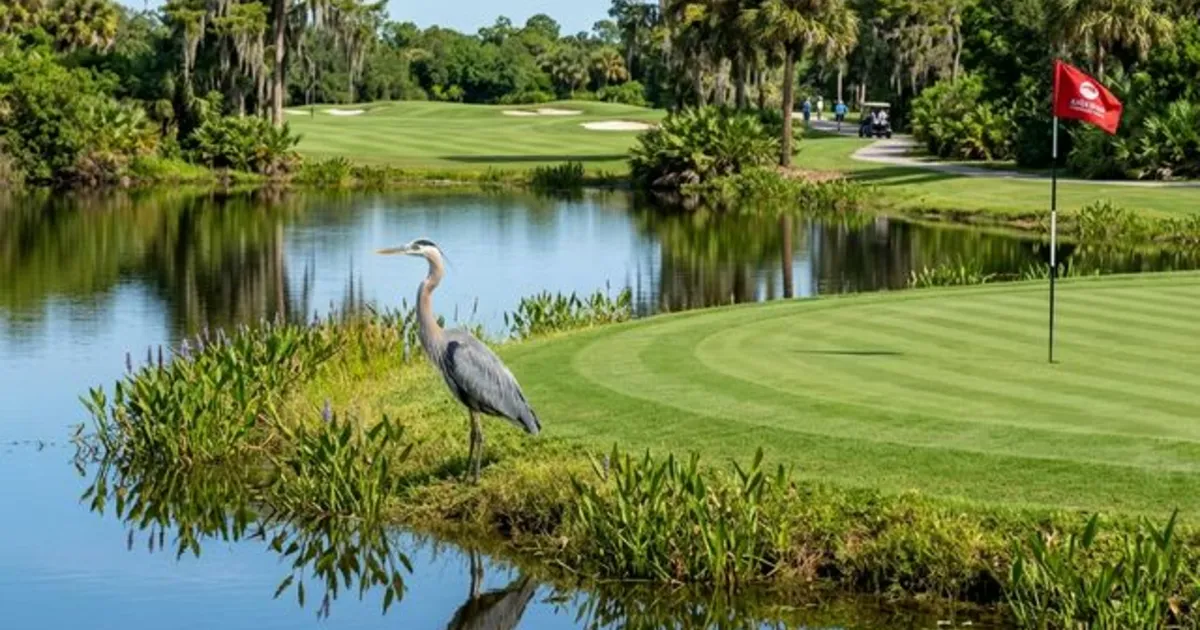
Wading birds are the most reliable sighting. Great blue herons, great egrets, tricolored herons, roseate spoonbills, and little blue herons all use golf course water features as foraging habitat.
They are largely indifferent to golfers, a heron standing in a pond twenty feet from a shot will not flush unless you walk directly at it. Wood storks, listed as threatened under the Endangered Species Act, are increasingly common on SWFL courses and reliably appear on courses with quality wetland buffers.
Gopher tortoises maintain burrows in upland areas of some certified courses, a significant indicator species because gopher tortoise burrows host hundreds of other species as commensals. Burrowing owls, Florida scrub-jays (where scrub habitat is adjacent), and osprey nesting on artificial platforms are all present across the region's better-managed properties.
Sandhill cranes nest on golf courses throughout SWFL and raise chicks in the open fairway corridors with remarkable success.
Our guide to the wildest wildlife on SWFL golf courses goes into considerably more depth on what to look for and where, but the short version is that certified courses consistently deliver more diverse and more abundant wildlife encounters than courses with minimal habitat management. This is not coincidental.
It is the direct result of the practices that earn and sustain certification.
Why This Matters in Southwest Florida Specifically
Environmental certification matters everywhere, but it matters more here than in most places. Southwest Florida sits at the interface of the Everglades system, the Big Cypress watershed, Charlotte Harbor, and the Gulf of Mexico.
The region's water management is a national issue, algae blooms in the Caloosahatchee, seagrass loss in Charlotte Harbor, and water quality in Naples Bay are not local footnotes. They are ongoing crises that involve the cumulative land use decisions of every property in the drainage basin, including golf courses.
Golf courses cover significant acreage in Collier and Lee counties. The collective water use, chemical application, and land management decisions of those courses have measurable downstream effects.
A course that reduces fertilizer application by 30 percent and eliminates runoff events through better timing does something real for the system as a whole. Multiply that by a dozen certified courses and the aggregate impact becomes consequential.
There is also a habitat fragmentation argument. Southwest Florida's natural areas have been heavily developed, the green infrastructure of golf courses, managed as wildlife habitat rather than just turf, serves as connective tissue between preserve parcels.
Certified courses that maintain habitat corridors allow species to move across fragmented landscapes in ways that a wall-to-wall mowed course cannot support. That is a real ecological function in a region where development pressure has continuously reduced and fragmented native habitat.
For golfers, the practical takeaway is simpler. Courses that invest in certification tend to invest in the same management disciplines, water quality, turf science, resource efficiency, that produce excellent playing conditions.
The environmental work and the conditioning work come from the same place. Choosing a certified course is not an act of ecological virtue.
It is choosing a facility that takes its responsibilities seriously, and that generally shows up in the experience.
Audubon International's certified course directory lets you search by state and confirm certification status before you book. It is a two-minute check worth doing if environmental performance is part of how you decide where to play.
FAQ
Is Audubon Cooperative Sanctuary the same as the National Audubon Society?
No. The Audubon Cooperative Sanctuary Program is run by Audubon International, a separate organization from the National Audubon Society.
They share historical roots but operate independently. Audubon International focuses specifically on environmental stewardship programs for golf courses, resorts, communities, and businesses.
The golf program is its largest and most established initiative.
How do I know if a course is actually certified and not just claiming to be?
Audubon International maintains a publicly searchable registry of certified courses on its website. Search by state and confirm current status directly.
If a course claims certification but does not appear in the registry, the claim is either outdated or inaccurate, the registry lists completed certifications only, not courses still enrolled and working toward the designation.
Does certification mean a course uses no pesticides or fertilizers?
No. Certified courses use pesticides and fertilizers, the certification requires that they use them responsibly, document their use, apply Integrated Pest Management principles to minimize inputs, and manage applications to protect water quality.
The goal is reduction, precision, and accountability, not elimination. Maintaining playable turf in Southwest Florida's subtropical climate requires active agronomic management.
Certification is about how that management is conducted, not whether it happens.
Are there other golf courses in Southwest Florida working toward certification?
Yes. Audubon International's enrollment program includes courses at various stages of the process.
The enrollment list is not publicly published like the certified list is, the best way to find out if a specific course is working toward certification is to ask the superintendent directly. Those involved in the program are generally straightforward about where they stand.
Does playing on an Audubon-certified course cost more?
Not as a direct function of certification. Green fees reflect the market position and quality of the facility.
Old Corkscrew and TPC Treviso Bay are premium courses by any measure, their pricing reflects that, not the certification. In practice, courses that invest in environmental management tend to be the same ones investing heavily in conditioning, so you often get a better experience, but you would be paying for that regardless.
auto_stories Recommended Reading