
Key Takeaways
- Tom Fazio has a deeper footprint in Southwest Florida than any other major architect, Old Collier, Gateway, Bonita Bay Club's East courses, Pelican Landing's The Nest, and Mediterra's two courses all carry his signature.
- Pete Dye's direct presence in SWFL is limited but consequential. Talis Park, the one course he co-designed here with Greg Norman, captures his characteristic philosophy: manufactured peril, psychological pressure, and shots that punish timid decision-making.
- Old Collier Golf Club is the regional benchmark for Fazio's work, walking-only, architecturally restrained, and consistently ranked among the top private courses in Florida.
- Gateway Golf and Country Club in Fort Myers offers Fazio design quality at semi-private access, making it the most reachable example of his work in the region for visitors without a private club connection.
- Understanding what each designer was trying to accomplish, and why, changes how you experience these courses from the first tee.
Two architects shaped the upper tier of Southwest Florida golf more than anyone else: Tom Fazio and Pete Dye. They approached the craft from opposite ends of the design spectrum, and the courses they left behind in this region reflect that difference in ways that become obvious the moment you step on the first tee.
Fazio built courses that felt inevitable, land used so logically that you couldn't imagine the holes running any other way. Dye built courses that made you feel like the land was arguing back.
If you want to understand why SWFL golf looks and plays the way it does at the highest levels, these two architects are where that story starts. For broader context on who else shaped the region's golf landscape, the architects who shaped Southwest Florida golf covers the full picture.
Tom Fazio's Southwest Florida Portfolio
Fazio built more elite courses in Southwest Florida than any other architect, and they span a range of settings, salt marsh, native pine flatwoods, lakeside corridors, and residential community land. What unifies them is a design sensibility that prioritizes visual comfort over visual intimidation.
Fazio's courses tend to look more playable than they actually are, which is a specific kind of skill. Golfers at every level feel welcomed off the tee, then discover the real difficulty at the green complex.
His work in SWFL concentrates in Collier and Lee counties, with courses ranging from one of the most celebrated private layouts in the country to a semi-private track in Fort Myers that most out-of-state visitors have never heard of. The quality is consistent across all of them, but the character differs considerably depending on when and where each was built.
Old Collier Golf Club, The Masterpiece
Old Collier Golf Club is the course most architecture writers point to when they want to argue that Fazio deserves more critical respect than he typically receives. It opened in 2001 on land that felt like Florida before Florida was developed, mangroves, salt marsh, native vegetation that Fazio routed around rather than cleared away.
The holes move through this landscape with a logic that looks effortless but required an enormous amount of design work to achieve.
The walking-only policy is worth noting specifically because it wasn't a marketing decision. Fazio designed Old Collier with the walking game in mind.
The course is routed so that the transition from green to tee feels natural on foot, the distances are manageable, and the pace of a walking round gives golfers time to read the terrain between shots. Riding the course would work technically, but you'd miss the point.
Golfweek consistently ranks Old Collier among Florida's top private layouts, and it appears on national top-100 lists with enough regularity that the designation no longer feels like news. Membership is deliberately limited, this is not a club where you can simply write a large check and get in.
Bonita Bay Club East, Volume and Variety
The Bonita Bay Club East courses represent a different phase of Fazio's career and a different kind of commission. Where Old Collier was built on land with inherent character, the Bonita Bay East property required Fazio to create interest from less dramatic raw material.
The results are polished without being memorable in the way Old Collier is memorable, good golf architecture in the service of a residential community rather than a destination in its own right.
Bonita Bay Club as a whole operates five courses, which gives its membership more variety than almost any other club in Southwest Florida. The East courses add that volume, and Fazio's design quality holds up well against the Arthur Hills layouts on the main property.
For members who play five days a week, that diversity matters practically more than architectural rankings.
The Club at Gateway, Semi-Private Access to Fazio Design
The Club at Gateway in Fort Myers is the most accessible Fazio course in Southwest Florida, and that access matters. The club operates semi-privately, members get priority, but outside play is available, which means visitors can experience Fazio's design work without a private club connection.
"The course was in excellent shape. Greens rolled the best that I've played so far in the Ft. Myers area."
Phillip2444582, GolfPass review
Green fees run considerably below what you'd pay at a resort course with comparable design credentials.
The layout runs through lakes and native vegetation in the Gateway corridor east of Fort Myers, and the Fazio pedigree shows in how the course uses water, strategically rather than decoratively. The carries are real decision points rather than visual props.
Gateway sits at a different point on the prestige spectrum than Old Collier, but the design fundamentals are the same: generous landing areas off the tee, complexity concentrated around the greens, and a course that plays more demanding than it initially appears.
The Nest at Pelican Landing, The Understated One
The Nest at Pelican Landing in Bonita Springs is a nine-hole Fazio design that often gets overlooked in discussions about his regional work, partly because nine holes don't generate the same attention as an 18-hole layout and partly because Pelican Landing doesn't market itself the way some of the larger private clubs in the area do. That's a mistake on the part of anyone who ignores it.
The Nest plays through native Florida terrain with the same design care Fazio applied to his larger commissions here. For members, it provides a quick round option when a full 18 isn't practical, and for anyone interested in how Fazio thinks about routing and green complex design, nine focused holes can be as revealing as eighteen average ones.
Pete Dye's Influence in Southwest Florida
Pete Dye didn't build a portfolio of courses in Southwest Florida the way Fazio did. His direct work in the region comes down primarily to Talis Park, where he collaborated with Greg Norman on a design that opened in 2011.
But Dye's broader influence on how high-end golf courses get built, particularly his approach to hazard design, green complexes, and the psychological architecture of difficult shots, runs through the region's design culture whether his name is on a scorecard or not.
Dye's career, documented extensively by the USGA following his death in 2020, was built on a philosophy of manufactured tension. He studied Scottish and Irish links courses in the early 1960s and came back convinced that American golf architecture had gotten too comfortable, too much about creating visually pleasant parkland settings and not enough about the psychological experience of a difficult shot.
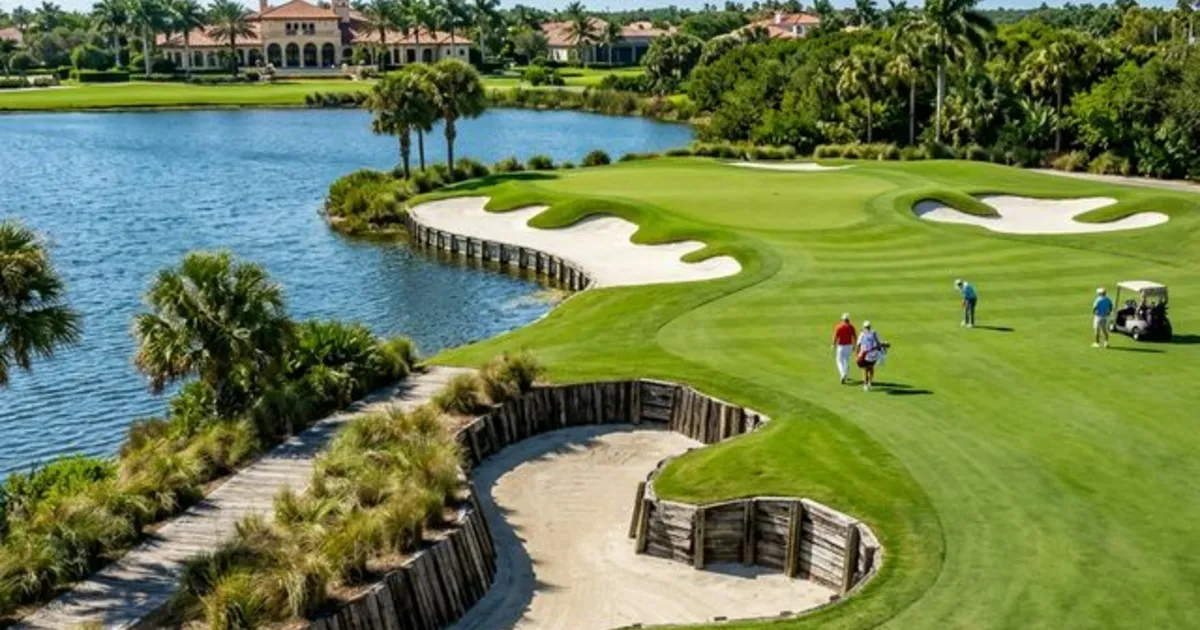
The railroad ties. The island greens.
The forced carries over water that leave absolutely no doubt about what a poor swing will cost you. These became his calling cards, and they changed what American golfers expected from challenging design.
Talis Park applies that sensibility in a Southwest Florida setting. The Norman-Dye collaboration is interesting because Norman's instinct runs toward wider, more strategic corridors while Dye's instinct runs toward confinement and penalty.
The result is a course that offers Norman's visual width in places while hiding Dye-style consequences, drop zones and green complexes that punish the approach shot you were afraid to hit but hit anyway. It's a private club in Naples, member and guest access only, and it carries a reputation for difficulty that its design pedigree fully supports.

How These Design Philosophies Play Out on the Course
The practical difference between playing a Fazio course and a Dye-influenced course in Southwest Florida comes down to where the difficulty lives and how it's communicated to you before you swing.
On a Fazio course, the opening shot typically looks manageable, wide fairway, generous landing zone, hazards that are visible but not immediately threatening. The pressure accumulates as you approach the green.
Fazio's putting surfaces are where handicaps get made or broken. Tier changes, false fronts, collection areas that funnel balls into trouble if you miss the correct quadrant, these are the features that separate Fazio's design from the architectural middle ground.
You walk off a Fazio course realizing the course was harder than it looked, and usually having enjoyed it more than you expected.
Dye communicated difficulty from the first tee. The threats are visible, sometimes melodramatic, and they are absolutely intentional.
A forced carry over a waste bunker. A narrow corridor bordered by water that makes the obvious line off the tee feel reckless.
Dye wanted you thinking about consequences before you pulled the club back, and he designed his courses so that the consequence for a poor decision was swift and obvious. Players who grew up on forgiving American parkland layouts sometimes find Dye-style courses unfair.
Golfers who prefer being tested psychologically find them the most honest courses ever built.
Neither approach is objectively superior, they're optimized for different golfer temperaments. For a broader comparison of how regional design influences stack up, the Nicklaus courses in Southwest Florida guide offers a useful contrast; Nicklaus's philosophy sits somewhere between Fazio's visual comfort and Dye's punitive edge.
Which Courses Should You Actually Play
Access determines the realistic answer for most golfers. Old Collier is the regional standout in Fazio's portfolio, but membership is restricted and there's no guest access without a member connection.
If you have that connection, the course should be on your list regardless of handicap, it's a genuine top-100 private layout and the walking experience is unlike anything else in the region.
For visitors without private club access, Gateway is the answer. Semi-private status, Fazio design credentials, and green fees that don't require a second mortgage.
It won't be confused with Old Collier architecturally, but the design fundamentals are sound and the access makes it the practical choice for anyone who wants to play Fazio without a membership.
Talis Park is the best place to experience Dye-influenced design in Southwest Florida if you can secure a guest invitation. The Norman-Dye collaboration produced a course with more visual drama than most private clubs in the region, and the difficulty is genuine rather than cosmetic.
It plays long from the back tees and punishing when the wind picks up, which in Southwest Florida, particularly in the afternoon, it usually does.
If you're specifically chasing Pete Dye's signature work and can travel, his courses at TPC Sawgrass, Harbour Town, and Whistling Straits represent his design philosophy at its most developed. Within SWFL, Talis Park is the best approximation of what Dye was after.
Within Fazio's regional body of work, Old Collier is the one that will stay with you.
Frequently Asked Questions
Did Pete Dye design any golf courses in Southwest Florida?
Pete Dye co-designed Talis Park in Naples with Greg Norman. It's the most direct example of Dye's design philosophy in the region, forced carries, severe green complexes, and the characteristic psychological pressure that defined his career.
Talis Park is a private club requiring member or guest access. Dye's broader influence on regional design standards is significant even beyond that single collaboration.
What Tom Fazio courses can visitors play in Southwest Florida?
The Club at Gateway in Fort Myers is the only Fazio course in Southwest Florida with consistent semi-private access for outside play. Old Collier, Bonita Bay East, The Nest at Pelican Landing, and Mediterra's two Fazio courses all require a membership or guest invitation.
Gateway is the realistic option for visitors who want Fazio design without a private club connection.
Is Old Collier Golf Club the best Fazio course in Florida?
Old Collier is consistently ranked among Fazio's finest works nationally, not just in Florida. Its combination of native terrain, restrained architectural ego, and the walking-only format puts it in a different category than most of his residential community commissions.
Architecture writers who are skeptical of Fazio's broader reputation tend to make exceptions for Old Collier, the design choices there reflect a designer at his most thoughtful.
How does Fazio's design style differ from Pete Dye's?
Fazio built courses that reward smart shot selection through visual accessibility and strategic green complexes, the difficulty is real but the course doesn't announce it aggressively. Dye built courses where the consequences of poor decisions are visible and immediate from the tee, with hazards and green complexes designed to penalize both the wrong shot and the timid shot.
Fazio courses tend to feel more welcoming off the first tee; Dye courses tend to feel more honest about what they're going to ask of you. Both approaches produce genuinely difficult golf when executed well.
Which Fazio course in SWFL is best for serious golfers?
Old Collier, without question, for anyone who can access it. The course rewards a complete game, accurate driving, precise iron play into complex greens, and strong putting on surfaces with significant movement.
For golfers without a member connection, Gateway offers the next-best Fazio experience in the region and gives you a course that will genuinely challenge anyone who plays it without proper course management.
auto_stories Recommended Reading