Key Takeaways
- Southwest Florida's winter weather rivals Arizona's on temperature, and adds water, wildlife, and a course network so dense you could play a different course every day for months.
- Green fees run competitive with Arizona at the mid-tier and meaningfully cheaper at the top end.
- Humidity is a non-issue from November through March.
- Travel logistics favor SWFL for anyone coming from the Midwest or Southeast.
- If course variety is the metric, Southwest Florida's course density is genuinely unmatched.

Every fall, snowbirds and winter golf travelers face the same fork in the road: head to Southwest Florida or book a week in Scottsdale. Arizona gets the headlines, big resort names, dramatic desert scenery, a reputation built over decades of magazine coverage.
But when you line the two destinations up on weather, cost, course quality, travel convenience, and what surrounds you while you play, SWFL holds up better than most people expect, and in several categories it wins outright. If you are choosing a home base for a winter season, the comparison deserves an honest look at all the variables, not just the marquee names.
Climate: Closer Than You Think, Different Than You Expect
The conventional wisdom is that Arizona is the dry, comfortable winter golf destination and Florida is hot and humid. That is accurate for about five months of the year, none of which are the winter golf window.
From mid-November through late March, Southwest Florida runs 72-82 degrees, humidity drops to levels that feel nothing like July, rain is minimal, and morning dew burns off quickly. This is as close to perfect golf weather as you will find anywhere in the country.
Arizona's winter climate is comparable on temperature, 65-75 degrees from December through February, but mornings run cold. December and January lows in the 40s are common in Phoenix, which pushes start times later than golfers want.
SWFL mornings rarely dip below 60, even in January. Earlier tee times are comfortable from day one.
The humidity concern deserves a direct answer: it is not a factor in peak season. The conditions that make a July round in Naples unpleasant are gone before snowbirds arrive.
What stays is warm, stable air that makes twilight golf enjoyable well into the evening, something Arizona's rapid temperature drop after sundown cannot always match.
Green Fees: The Real Numbers
At the top tier, both markets are expensive. Peak season rounds at Scottsdale's premier resort courses run $250-$500. Comparable SWFL tracks, TPC Treviso Bay, Tiburon Gold, also hit that tier. But the volume of quality courses below $150 is substantially higher in Southwest Florida.
At the mid-range, the courses most traveling golfers actually play most often, SWFL holds a consistent pricing edge. A solid semi-private course in the Naples or Fort Myers corridor runs $80-$150 in peak season.
An equivalent course in the Phoenix metro runs $100-$175. At the public and municipal tier, the gap widens further.
Florida's municipal infrastructure in Lee and Collier Counties keeps legitimate golf available under $75 that Arizona's market has largely priced out near the major golf corridors. Twilight rounds hold up better in SWFL too, the weather stays comfortable into the evening, and Florida's eastern time zone means more daylight to work with.
Course Quality and Variety
The conversation about course quality should include depth and accessibility, not just the top five names. On that basis, Southwest Florida is harder to beat.
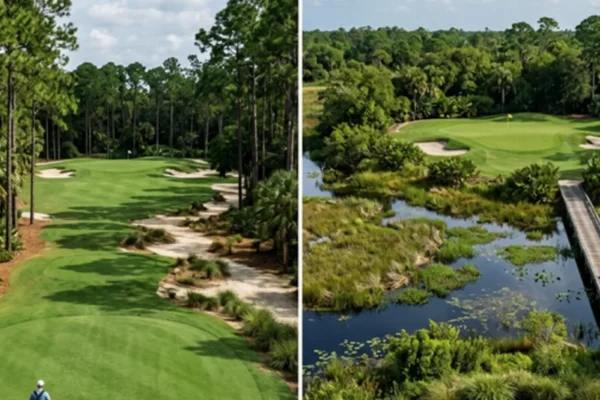
Old Corkscrew Golf Club in Estero is a Jack Nicklaus Signature design that competes with anything Arizona offers in its price tier, natural wetlands, native vegetation, strategic bunkering, and a layout that holds up to repeat rounds without feeling repetitive.
"One of best in Fort Myers/Naples area. Scenic well designed tour quality Jack Nicklaus course. Difficult to score well but enjoyable and challenging. Must play."
krv1950, GolfPass review
TPC Treviso Bay in Naples is a PGA Tour-quality facility with an Arthur Hills design that integrates water features and Florida scrub landscape in a way that produces a genuinely memorable round. Unlike some of Arizona's premium tracks, Treviso Bay offers public access pathways without requiring a resort stay or membership connection.
"Always a pleasure playing at TPC Treviso. Nice layout and challenging holes with fast greens."
napolidon2012, GolfPass review
Tiburon Golf Club's Gold Course at the Ritz-Carlton Golf Resort in Naples is a Greg Norman design that plays firm and fast, with wide sightlines, strategic water, and conditioning that ranks among the best-maintained in Florida. This is a course that would anchor any Arizona resort portfolio.
Beyond the marquee names, the depth of the market is where the real argument lives. Lee and Collier Counties host well over 100 courses, private, semi-private, resort, and public, across every price point and design era.
A Scottsdale visitor for a week will likely play the same eight courses every visitor plays. A SWFL golfer for a full season could play a different course every round for months and never exhaust the quality options.
That variety is not something Arizona's more concentrated golf infrastructure can match.
Water Features and Wildlife: Florida's Signature Advantage
Desert golf has its own visual identity, saguaro cactus framing a fairway, red rock ridgelines in the distance, green turf against brown sand. It photographs well. But there is a different category of course experience that only Florida delivers.
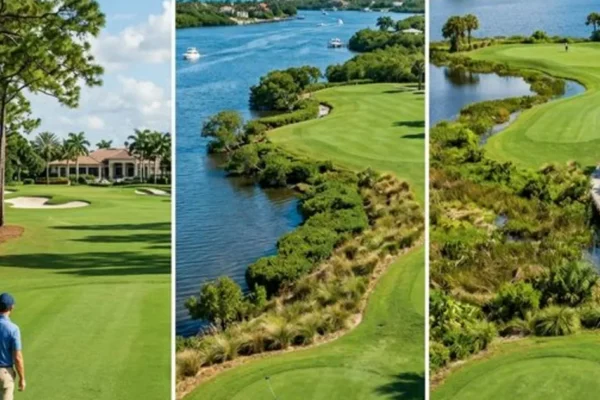
Playing golf in Southwest Florida in winter means sharing the course with active wildlife in a way that has no Arizona equivalent. Roseate spoonbills on a par-three shoreline.
Great blue herons at the water's edge during your approach. Osprey on course markers.
Sandhill cranes crossing fairways. The occasional alligator on a bank, close enough to be interesting, far enough that experienced players barely break stride.
The list is genuinely long and changes by location and season.
Water features in SWFL are architectural elements integrated with a real ecosystem. Courses built around existing wetlands and preserves create carry challenges, visual depth, and wind interactions that manufactured water features cannot replicate.
Arizona's water features exist in contrast to their surroundings. Florida's exist as part of a connected system with real wildlife habitat.
After a few rounds, course variety becomes as much about sensory experience as layout difficulty, and that is where SWFL's environment delivers something desert golf simply cannot.
Travel Convenience
Southwest Florida Regional Airport in Fort Myers has direct service from most major Midwest and Southeast hubs, Chicago, Detroit, Cleveland, Toronto, Cincinnati. The cities that produce the bulk of Florida's snowbird population are well-served.
Phoenix Sky Harbor is a strong national airport, but the flight paths from the Great Lakes and Ohio Valley region make Fort Myers the more direct option for the largest segment of winter golf travelers.
Once you land, SWFL's golf infrastructure is compact. Naples, Bonita Springs, Estero, Fort Myers, and Cape Coral together cover a geography where the vast majority of courses are within 30-45 minutes from a central base.
The region is also built for seasonal visitors in a way few golf destinations match, dining, medical, retail, and everyday services are sized for a population that roughly doubles in winter. That matters over a multi-month stay in a way a week-long trip does not fully reveal.
Lodging Costs
Scottsdale's peak season commands some of the highest short-term rental rates in the country, $5,000-$8,000 per month for a quality two-bedroom unit near the golf corridor. Resort hotel rates at properties with on-site golf regularly exceed $400 per night from January through March.
Southwest Florida's seasonal rental market has risen in recent years, but the volume of available inventory keeps average prices below comparable Arizona markets. A two-bedroom condo in Naples or Bonita Springs runs $3,500-$6,000 per month during peak season.
Fort Myers and Cape Coral options are available below $3,000 at solid quality levels. For a seasonal stay, that difference adds up quickly.
Our snowbirds guide to golf in Southwest Florida covers cost planning and seasonal membership options in detail.
The Bottom Line
Arizona golf deserves its reputation. The desert landscape is unlike anything else in American golf, and the concentration of major-design courses in the Scottsdale corridor makes it a genuine bucket-list destination.
But for a winter golf home base, especially a seasonal stay, Southwest Florida wins on the metrics that matter most over time. The weather comparison is closer than most people expect.
The green fee advantage is real at every tier below the very top. Course depth and variety are genuinely superior.
The wildlife and water experience adds a dimension that desert golf cannot provide. Travel logistics favor SWFL for the largest segment of winter golf travelers.
And lodging costs come in below comparable Arizona options across most market segments.
The golfers who come to Southwest Florida for a week often come back for a month. According to Golf.com's annual destination coverage, Florida consistently places among the top winter golf destinations in the country, and SWFL is a significant reason why.
National Club Golfer has noted Florida's combination of course density, winter weather, and wildlife setting as increasingly attractive to international visitors as well. If the goal is months of excellent golf at competitive prices, surrounded by water and wildlife, with easy logistics and comfortable lodging, Southwest Florida is the answer.
FAQ
Is Florida golf too humid in winter compared to Arizona?
No. The humid conditions that make summer golf in Florida uncomfortable do not apply to the November-through-March window.
Southwest Florida's winter humidity is low enough that most golfers from the Midwest or Northeast find conditions more comfortable than they expected based on Florida's summer reputation.
Are green fees in Southwest Florida really cheaper than Arizona?
At the mid-tier and public level, yes, meaningfully so. Arizona's Scottsdale market has a high concentration of premium-priced resort courses that pull average green fees up.
SWFL has a deeper inventory of quality courses in the $80-$150 range and a stronger public tier below $75. At the very top, resort and private-access guest rates, the two markets are comparable.
How does course quality in SWFL compare to Scottsdale?
The top courses in both markets are world-class. The meaningful difference is depth: Southwest Florida has a much larger inventory of quality courses across all price tiers, which is what matters for a multi-week or seasonal stay.
Scottsdale's premier courses are exceptional, but the breadth of accessible options below the resort tier is stronger in SWFL.
What makes Southwest Florida golf courses different from desert courses?
Water, vegetation, and wildlife. SWFL courses integrate natural wetlands, lakes, and preserve areas into their layouts, creating a visually distinct and environmentally active setting.
The wildlife, herons, spoonbills, osprey, sandhill cranes, and alligators, is a genuine part of the round in a way that has no equivalent in Arizona's desert environment.
Is it easier to fly to Southwest Florida or Scottsdale from the Midwest?
For most Midwest cities, Southwest Florida is the easier trip. Fort Myers' RSW airport has strong direct service from Chicago, Detroit, Cleveland, Columbus, and Cincinnati.
Phoenix is well-served nationally, but flight paths from the Great Lakes and Ohio Valley generally make Fort Myers the more direct option.
How much does it cost to rent a place for a golf season in SWFL vs Scottsdale?
Monthly rental rates in peak season run $3,500-$6,000 in Naples and Bonita Springs for a quality two-bedroom unit, with more affordable options in Fort Myers and Cape Coral below $3,000. Comparable quality in Scottsdale's golf corridor typically runs $5,000-$8,000 per month.
SWFL carries a consistent lodging cost advantage for seasonal stays across most market segments.
auto_stories Recommended Reading