Key Takeaways
- Atlantic hurricane season runs June 1 through November 30, overlapping almost entirely with Southwest Florida's summer golf calendar.
- Golf courses begin storm preparations weeks before a storm threatens, draining lakes, staking trees, and securing equipment.
- Post-storm closures can last anywhere from a few days to several months depending on damage severity.
- Hurricane Ian (September 2022) caused catastrophic damage to courses across Lee County, with some still carrying visible scars today.
- Green fees and membership rates can shift after a major storm as courses recover costs and manage reduced rounds.
- Knowing a course's storm history and closure policies before you book can save you a wasted trip.
If you have played golf in Southwest Florida for any length of time, you already know the deal: the region offers some of the best winter golf in the country, but from June through November, Mother Nature holds the scheduling authority. Hurricane season is not just a weather phenomenon here, it is a fundamental part of how courses plan, operate, and price their product.
Understanding how storms affect the courses you play makes you a smarter golfer and a more prepared visitor.
The Hurricane Season Timeline and What It Means for Golfers
The National Hurricane Center defines the Atlantic hurricane season as June 1 through November 30. That six-month window lines up almost perfectly with Southwest Florida's off-season golf calendar, the stretch of months when temperatures are higher, humidity is heavy, and prices are lower.
The peak of the season falls between mid-August and mid-October, with the statistical peak around September 10. This is also when the Gulf of Mexico's warm surface temperatures provide maximum fuel for storm development.
Golfers planning extended stays or snowbird trips should treat that mid-August through mid-October window as the period of highest risk, even though storms have struck SWFL well outside those dates.
For most summers, hurricane season passes without a direct hit. But "most summers" is not a guarantee, and even a storm that makes landfall elsewhere can bring tropical-storm-force winds, heavy rain, and flooding to the region, all of which shut down play and cause real damage to courses.
If you are planning summer golf and want a broader picture of the seasonal conditions, our guide to summer golf in Southwest Florida covers what to expect month by month.
How Golf Courses Prepare Before a Storm
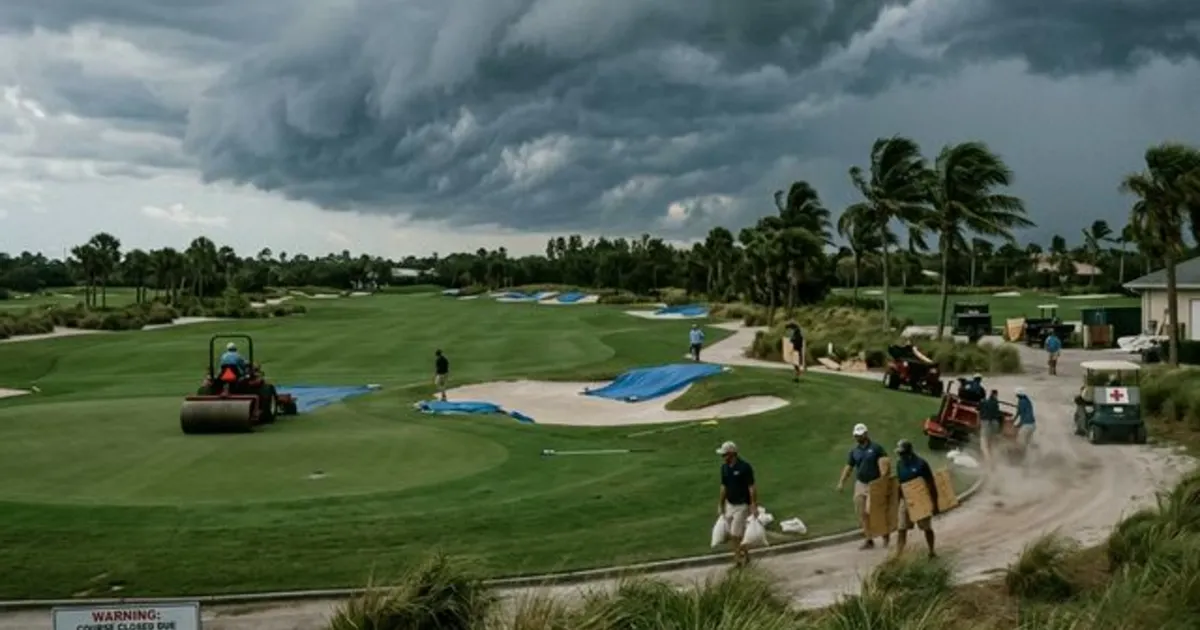
Course superintendents in Southwest Florida treat storm preparedness as a year-round discipline, not a last-minute scramble. When the National Weather Service issues a watch or warning for the region, most courses already have a checklist in motion.
Typical preparation steps include:
- Lowering lake levels. Course water features and retention ponds are deliberately drained down several feet before a storm to create capacity for the surge of rainfall that typically accompanies a hurricane. A course that skips this step risks flooding that takes weeks to recede.
- Securing or removing equipment. Ball washers, range pickers, beverage carts, flagsticks, and signage all get pulled in. Loose equipment becomes projectile debris in high winds.
- Staking and cabling trees. Younger trees, especially those planted in landscaping along fairways, are staked or cabled to reduce wind throw. Mature palms are generally left alone; their flexible fronds shed wind far better than they look.
- Protecting the clubhouse. Impact shutters, generator fueling, and sandbag placement around low points are standard. The clubhouse is both a business asset and often a staff staging area after the storm passes.
- Documenting conditions. Superintendents photograph every hole, every structure, and every piece of equipment before a storm. This documentation is critical for insurance claims after the fact.
Most courses close to play 24 to 48 hours before projected landfall. Staff members with specific storm duties may remain on-site through the event.
What Happens to a Course During a Major Storm
The damage a hurricane inflicts on a golf course depends heavily on the storm's track, intensity, and speed of movement. A fast-moving storm can deliver a punishing wind event but relatively limited flooding.
A slow storm, or one that stalls, can drop 20 to 30 inches of rain, pushing even well-prepared lake systems well beyond capacity.
Common categories of storm damage on golf courses include:
- Tree loss. This is almost universal in a direct hit. Even courses with mature tree canopies can lose dozens to hundreds of trees, depending on species and root system depth. Live oaks and sabal palms fare better than pines and exotic ornamentals.
- Turf damage. Flooding, salt intrusion, and debris smothering greens and fairways can kill turf rapidly. Greens are especially vulnerable, a green buried under debris and standing water for more than a day or two may require full resodding.
- Irrigation and drainage infrastructure. Underground pipes, pump stations, and control systems can be damaged by debris impact, ground shifting, or power surge. Repair timelines for irrigation systems often drive the overall course reopening schedule.
- Structures. Maintenance buildings, cart storage, pro shops, and restroom facilities are all at risk. Roof loss is common even in Category 1 and 2 events.
Recovery, Cleanup, and Reopening
The first priority after a storm is always safety, downed power lines, unstable trees, and flooded cart paths create real hazards. Superintendents and ownership typically walk the property before any crew or public access is allowed.
Reopening depends on a safety inspection, utilities, access roads and the extent of repairs. An operator may restore only part of the course at first; there is no reliable one-to-three-week timetable for every moderately damaged property.
Severe damage pushes that timeline to months.
Many courses reopen in stages, running a reduced number of holes while repair work continues on others. Partial reopenings allow the course to generate some revenue and give members somewhere to play, even if the full 18 is not yet available.
Labor is often the bottleneck. The same storm that damaged the course also displaced workers, damaged their homes, and created competing demand for every contractor in the region.
A course that suffered $500,000 in damage may wait months longer for repairs simply because licensed roofers and irrigation contractors are backed up across the county.
Hurricane Ian's Lasting Impact on Southwest Florida Golf
Hurricane Ian made landfall near Cayo Costa on September 28, 2022, as a Category 4 storm with maximum sustained winds of 150 mph. It was one of the strongest landfalls ever recorded on the U.S.
Gulf Coast, and its track directly through Lee County placed virtually every golf course in the region inside the damage zone.
The devastation was not uniform, but it was widespread. Courses closer to the coast and those on or near barrier islands absorbed the worst of the storm surge.
Sanibel Island Golf Club was among those facing the dual challenge of wind and water, the barrier island itself was cut off when the causeway sustained major damage, delaying not just course repairs but the entire recovery of the island's infrastructure.
Inland courses in the Fort Myers and Cape Coral areas faced severe wind damage and flooding without the added complexity of storm surge, but the sheer volume of debris, downed trees, displaced equipment, structural damage, made recovery timelines stretch well into 2023 for some facilities. Fort Myers Country Club and other established courses in Lee County faced the challenge of rebuilding while also managing member expectations and revenue pressure.
"This is what great affordable golf should be like."
TimGavrichGP, GolfPass review
Public courses like Coral Oaks Golf Course in Cape Coral had to navigate both the physical repairs and the reality of reduced municipal budgets stretched thin by citywide disaster response. Getting public facilities back online required coordination between course management, city departments, and insurance adjusters, a slower and more bureaucratic process than a privately owned club faces.
"The greens were in excellent shape and were fast! You won't be disappointed."
ericbjornson, GolfPass review
More than three years later, Ian's fingerprints are still visible across the SWFL golf landscape. Some courses completed comprehensive renovations under the cover of insurance recovery, replacing aging irrigation systems, resodding fairways with improved turf varieties, and rebuilding clubhouses that had outlived their useful life.
In that sense, Ian forced upgrades that might not have happened for another decade. But it also closed courses permanently, reduced the region's total golf inventory, and altered the character of courses that lost irreplaceable mature tree canopies.
Course Insurance and What It Covers
Golf courses in Southwest Florida carry a combination of property insurance, equipment coverage, and, critically, business interruption insurance. Business interruption coverage compensates a course for lost revenue during the period it cannot operate, which can mean the difference between a course surviving a major storm and closing permanently.
Florida's insurance market was under significant stress before Ian, and the storm accelerated a crisis that has continued in the years since. Premiums for commercial properties in Southwest Florida, including golf courses, rose sharply after 2022.
Several insurers exited the Florida market entirely, pushing courses toward Citizens Property Insurance or surplus lines carriers at higher rates.
The practical effect for golfers is that insurance costs are now baked into course operating budgets in a way they were not a decade ago. Some of that cost eventually flows through to green fees and membership rates, even at courses that did not suffer direct storm damage.
How Storms Affect Green Fees and Membership Pricing
The pricing effects of a major hurricane are not always intuitive. In the immediate aftermath of a storm, courses that escaped significant damage often see a surge in demand, golfers from harder-hit courses need somewhere to play, and a functional course can charge accordingly.
In the months after Ian, courses that reopened quickly found themselves absorbing far more rounds than normal.
A reduced number of holes or repair work may affect the offer, but a discount is not guaranteed. Confirm the playable layout and full price before reserving.
Some courses offered prorated membership refunds or credits during extended closures, while others held firm on annual dues while working through repairs.
Storm damage can affect operating costs and available rounds. This article does not establish how much of any current green fee is attributable to a specific hurricane.
It is worth noting that hurricane season already overlaps with the period of lowest green fees in the region. Summer and early fall rates are discounted relative to peak winter season, which partly offsets the added risk of playing during an active period.
For more on navigating daily weather during this season, see our post on afternoon thunderstorms and what Florida golfers need to know.

Practical Advice for Golfers During Hurricane Season
Playing golf in Southwest Florida during hurricane season is perfectly reasonable, the vast majority of summer rounds happen without any storm interference. But a little preparation goes a long way:
- Book refundable tee times when possible. Many online booking platforms allow cancellations. If you are visiting during peak storm season, avoid prepaid non-refundable packages that leave you holding unusable tee times if a storm forces closure.
- Check the course's social media before you drive. Most courses post closure announcements on Facebook or Instagram before they update their websites. A quick check saves a wasted trip.
- Understand the course's storm history. Courses that flooded badly during Ian may be more vulnerable to flooding in future events. Knowing the terrain and drainage history of a course you plan to visit frequently is useful context.
- Monitor the National Hurricane Center during active periods. The five-day forecast cone is your best planning tool. If a storm is being tracked toward the Gulf during your travel window, have a contingency plan.
Frequently Asked Questions
How long does it take a golf course to reopen after a hurricane?
There is no standard reopening period. Wait for the operator's dated announcement and confirm how many holes and facilities are available.
A course that suffered major flooding, structural damage, or irrigation system failure could be closed for several months. Courses sometimes reopen in stages, running fewer holes while repairs continue.
Did Hurricane Ian permanently close any golf courses in Southwest Florida?
Yes. While most courses eventually reopened, some properties in the hardest-hit areas did not return to operation.
The combination of physical damage, insurance complications, and ownership decisions led to the permanent closure of a small number of facilities. The region's overall golf course inventory contracted after Ian.
Are green fees lower during hurricane season?
Summer quotes may be lower than winter prices, but compare the actual date and course. A storm-related closure or reduced layout requires a separate check.
The combination of heat, humidity, and storm risk drives seasonal pricing down. That said, courses that are operating at reduced capacity post-storm may price differently than their normal summer rates.
When is the safest time to play golf in Southwest Florida during hurricane season?
June and early July carry the lowest storm probability within the official season, though no period is risk-free. The highest-risk window is mid-August through mid-October.
November technically falls within hurricane season but historically sees far fewer Gulf storms, and most courses are running at full capacity with improving weather conditions by then.
What should I do if a hurricane threatens while I am visiting Southwest Florida to golf?
Follow local emergency management guidance first, golf is secondary to personal safety. Monitor the National Hurricane Center for official forecasts.
If an evacuation order is issued for the area where you are staying, comply with it. Most courses will be closed well before a storm arrives, so the decision point for golfers typically comes down to whether to leave the region entirely or shelter in place at a substantial structure away from the coast.
How do golf courses handle member dues during a storm closure?
Policies vary widely by course and by the terms of individual membership agreements. Some courses offer prorated credits or dues suspensions during closures that exceed a defined threshold.
Others maintain normal billing throughout, citing ongoing operating costs even when the course is closed. It is worth asking about a course's storm closure policy before signing a membership agreement, particularly at facilities with known flood vulnerability.
auto_stories Recommended Reading