Key Takeaways
- Public courses in Southwest Florida can deliver excellent value, especially in summer when green fees drop well below $75.
- Private clubs cost far more upfront, but that cost buys consistency: conditioning, pace of play, and access that public courses simply cannot guarantee.
- The honest break-even math on private membership rarely works in the member's financial favor, the real value is lifestyle, not savings.
- Pace of play is where public golf frustrates players most; private clubs structure their tee sheets specifically to prevent it.
- For visitors and occasional players, Southwest Florida's public inventory is strong enough that private access is not necessary to have a great experience.
The question comes up constantly on Southwest Florida golf forums, in pro shop conversations, and over post-round beers: is a private club membership actually worth it, or are you just paying for a logo on your shirt? It is a fair question, and the answer is more nuanced than either side usually admits.
Public golf advocates will tell you the public tracks down here are outstanding, and they are right. Private club members will tell you there is no comparison once you have played inside the ropes, and they are also right.
Both things can be true simultaneously, because they are measuring different things.
This is not a debate about which option is better in the abstract. It is a practical breakdown of what each tier actually delivers so you can make a clear-eyed decision based on your situation.
What the Public Side Actually Looks Like
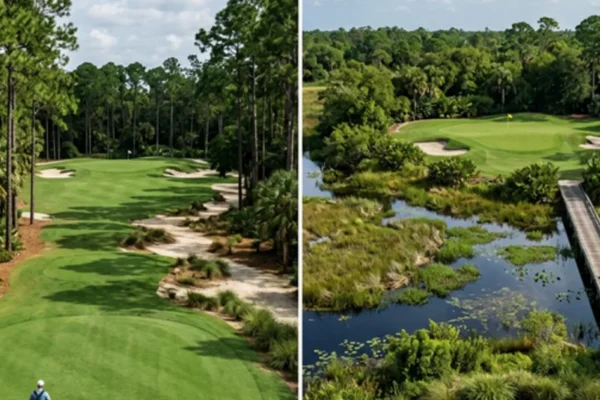
Southwest Florida has a stronger public golf inventory than most people outside the region realize. You are not choosing between a handful of mediocre municipal tracks.
Courses like Old Corkscrew Golf Club in Estero regularly show up on national rankings, and county-operated facilities like Eastwood Golf Course in Fort Myers offer solid, maintained conditions at accessible price points.
"One of best in Fort Myers/Naples area. Scenic well designed tour quality Jack Nicklaus course. Difficult to score well but enjoyable and challenging. Must play."
krv1950, GolfPass review
The public tier in this market spans a wide range. You have resort-access semi-private courses, daily fee tracks with minimal restrictions, county-operated courses aimed squarely at residents, and everything in between.
Pricing in-season (roughly November through April) typically runs $80 to $150 for a quality tee time at a top public facility. Summer rates, when locals play most of their golf, drop significantly, often landing under $50 at courses that charge twice that in January.
For a deeper look at what is available without a membership card, the 10 best public golf courses in Naples for visitors covers the strongest options across the Naples corridor specifically.

What Private Actually Gets You
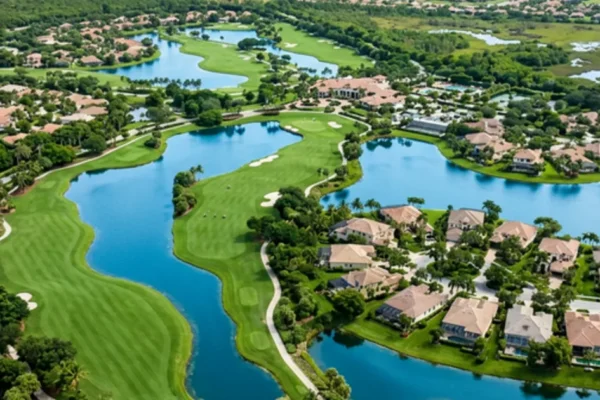
Private club membership in Southwest Florida is not a monolith. There are equity clubs where you buy a stake in the property.
There are non-equity clubs where you pay an initiation and monthly dues with no ownership interest. There are bundled communities where golf is included with your real estate purchase.
And there are tiered membership structures that give you golf access but not full social privileges, or social privileges but limited tee times.
Initiation fees at top Naples-area private clubs start around $50,000 and climb well past $150,000 for the most prestigious. Monthly dues typically run $800 to $2,000 on top of that, with food minimums, cart fees, and assessment exposure layered on.
Grey Oaks Country Club in Naples sits at the upper end of this market, the type of club where the membership investment itself signals something about who belongs there.
Then there is the semi-private middle ground. TPC Treviso Bay blends private-club conditions with some public access elements, giving players a closer look at what the private experience feels like without the full equity commitment.
"Always a pleasure playing at TPC Treviso. Nice layout and challenging holes with fast greens."
napolidon2012, GolfPass review
It is a useful data point when evaluating whether the jump to full private membership makes sense for you.
If you are seriously considering the private route, the full breakdown at private golf clubs in Naples, what you need to know about membership will walk you through how the initiation, dues, and ancillary costs actually stack up.
Conditioning: The Honest Comparison
Course conditioning is where the private-vs-public gap is most tangible and most consistent. Private clubs typically maintain their greens at stimpmeter readings of 10 to 12 or higher during season.
Fairways are overseed earlier, tighter, and with more attention to coverage. Bunker sand gets refreshed on a schedule that would be financially impossible for a daily fee operation.
The practice facilities, range, short game area, putting green, are maintained to the same standard as the course itself.
Public courses are not universally inferior, but their conditioning varies with revenue, staffing, and weather in ways private clubs are insulated from. A top-tier public course in Southwest Florida will give you excellent conditions most of the time.
What it cannot guarantee is the kind of day-in, day-out consistency that members at a well-funded private club come to expect as baseline. After a stretch of heavy rain or during a particularly crowded in-season weekend, that gap becomes visible.
Summer is the great equalizer. Maintenance quality at well-run public tracks during the off-season months often rivals what you would find inside private gates, and the price difference becomes hard to justify on conditioning alone.
Pace of Play: Where Public Golf Loses Most Players
Ask any serious golfer why they considered private membership, and pace of play comes up within the first two minutes. A four-hour round at a well-managed private club is the norm. A four-and-a-half-hour round at a busy public course in January is also the norm, but the wrong kind.
Private clubs control their tee sheets in ways public courses cannot. Starter density is lower.
Members know the pace expectations. The culture around keeping up is enforced by peer accountability in a way that simply does not exist when strangers are paired together for a one-time round.
Slow groups get a quiet word from the pro shop; repeat offenders get a direct conversation with the director of golf.
Public course operators do what they can, staggered tee times, rangers on course, pace tracking, but they are working against a customer base with wildly different skill levels, expectations, and experience. During peak season in Naples or Fort Myers, five-hour rounds happen.
If that genuinely ruins your experience, it is a real cost that does not show up in any green fee comparison.
The Social Dimension
Private clubs sell something beyond golf. The dining room, the member events, the standing Tuesday game with the same four guys, that is a genuine lifestyle product, and for the right person it is worth a significant premium.
Southwest Florida has a large population of retirees and seasonal residents who moved here specifically to build a social life around golf. For that demographic, the club is not just where they play, it is where they eat three nights a week, where they know the bartender's name, where their kids swim in the summer.
The golf course is almost incidental to the broader relationship with the place.
Public golf offers none of that, and it is not trying to. You show up, you play, you leave.
For plenty of golfers, especially working-age players with limited time, that is exactly the right model. There is no food minimum to hit, no committee meeting to attend, no social obligation attached to the membership.
The transactional nature of public golf is a feature, not a bug, depending on what you are looking for.
The Cost Analysis: Breaking Down What You Actually Pay
Here is where the math gets uncomfortable for private club advocates. Take a hypothetical mid-tier private club with a $75,000 initiation fee and $1,200 per month in dues.
Over ten years, even before food minimums, cart fees, and assessments, you are looking at $75,000 plus $144,000, $219,000 in base costs. At a blended average of $80 per round at quality public courses, that covers 2,737 rounds of golf.
Playing twice a week, every week, for ten years is 1,040 rounds. The numbers do not support the private club on golf economics alone.
Private club members understand this. Nobody serious about the math joins a private club expecting to come out ahead on a per-round basis.
They join for guaranteed access during peak season, for conditions they can count on, for pace of play they can plan around, and for the social fabric that comes with it. Those are real values.
They just are not financial values.
If the priority is playing great golf at reasonable cost, the public inventory in Southwest Florida is rich enough to serve that need well. The best golf courses under $75 in Naples and Fort Myers demonstrates the range of quality available without a membership card.
When Private Membership Actually Makes Sense
Private makes sense when the non-golf benefits are genuinely part of your life, not just theoretical. If you are going to use the dining room regularly, attend member events, build friendships through the club, and rely on the club as a social anchor, particularly if you are retiring to Southwest Florida full-time, the total value proposition is much stronger than the golf math alone suggests.
It also makes sense if pace of play and guaranteed tee time availability during January and February are genuinely worth significant money to you. Walking onto Old Corkscrew or another top public track on a Saturday in peak season is not impossible, but it is not the experience a private member has on their home course.
If that distinction matters enough to act on, it is a legitimate reason to explore membership.
And it makes sense if you are purchasing bundled real estate anyway, in which case the golf access is part of a larger lifestyle decision rather than an isolated line item.
When Public Is the Better Call
Public is the right answer for visitors, for golfers who play fewer than 50 rounds per year, for working-age players who value flexibility over belonging, and for anyone not prepared to fully engage with the social obligations that come with club membership.
It is also the right answer for players who want to experience variety. Southwest Florida's public and semi-private inventory spans a genuinely impressive range of design styles, difficulty levels, and settings.
A private member plays their home course most of the time. A public golfer working through the region's top tracks has access to that entire range without committing to any single property.
The Golf Digest course ratings program and similar third-party rankings have consistently recognized public courses across the country as capable of matching private layouts on design quality. Southwest Florida is no exception.
The conditioning gap is real, but it is not so wide that public golf is a lesser experience, it is a different one.
The Bottom Line
Neither option is objectively superior. Private golf in Southwest Florida offers a controlled, consistent, socially rich experience, at a price that only makes sense if you are going to use everything the club provides, not just the golf course.
Public golf offers flexibility, variety, and value that no private club can match on a per-round basis, with the trade-off of less predictable conditions and pace.
Be honest about how you actually use a golf club versus how you imagine using it. The golfer who plays 30 rounds a year and prefers Saturday mornings with whoever shows up has no business paying private club dues.
The golfer who retires to Naples and wants a built-in social community centered around golf might find that the initiation fee is the best money they ever spent.
Figure out which golfer you are, and the decision largely makes itself.
Frequently Asked Questions
What is the average cost of a private club initiation fee in Southwest Florida?
Initiation fees at private clubs in the Naples and Fort Myers area typically range from around $50,000 at the lower end to $200,000 or more at prestigious equity clubs. Mid-tier clubs with full golf and social access generally fall in the $75,000 to $125,000 range.
Monthly dues on top of that run $800 to $2,000 depending on the club and membership category.
Can visitors play at private golf clubs in Southwest Florida?
Most fully private clubs in the region do not offer public tee times. Some allow guests of members to play, and a few semi-private operations like TPC Treviso Bay provide limited public access.
For visitors, the strong public and resort course inventory in Southwest Florida makes private access largely unnecessary for a high-quality experience.
Is public golf in Naples and Fort Myers worth it compared to private?
For most visitors and non-resident golfers, absolutely. The region's public inventory includes nationally ranked courses with excellent conditions, particularly during the summer off-season when rates drop substantially.
The trade-off versus private is primarily in pace of play consistency and the social amenities, not in raw golf course quality.
How does pace of play differ between public and private courses?
Private clubs maintain tighter tee sheet control and enforce pace expectations through member culture and staff accountability. Four to four-and-a-quarter hours is a typical round at a well-run private club.
Public courses during peak season in Southwest Florida can run four-and-a-half to five hours on busy days, particularly in January and February when visitor volume is highest.
When does private membership become worth the cost in Southwest Florida?
Private membership makes the most financial and lifestyle sense for full-time or long-season residents who will use the club's social and dining facilities regularly, play 80 or more rounds per year at their home club, and value guaranteed peak-season access and consistent conditions enough to treat those as genuine priorities, not just nice-to-haves. For occasional players or visitors, the public market is the better value by a wide margin.
auto_stories Recommended Reading