Ask any golfer who plays Southwest Florida year-round and they will tell you the same thing: the courses look different in January than they do in July. The grass is different, the greens roll differently, and every now and then you show up to find a course partially closed for a week or two.
None of that happens by accident. What you see on the course in peak season is the direct result of months of work that happens when most snowbirds are still back up north.
Key Takeaways
- SWFL courses use the summer off-season, roughly May through October, to perform maintenance that would be impossible during peak play.
- Aerification and overseeding are the two most impactful turf management practices, and they require temporary course closures or reduced access to do correctly.
- Bermudagrass is the base turf across nearly all Southwest Florida courses; ryegrass is overseeded on top of it for winter color and playability.
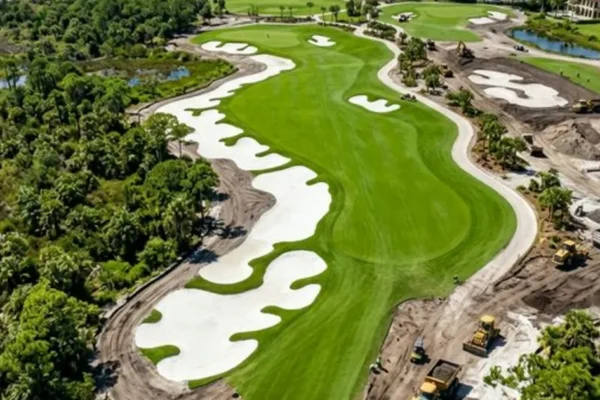
- Irrigation system upgrades, drainage work, and green rebuilds typically happen in summer when the risk of disrupting peak-season rounds is lowest.
- Superintendents work backward from a target opening date, usually November 1, to schedule every maintenance phase in sequence.
- Temporary closures and cart path restrictions are signs a course cares about conditioning, not signs of poor management.
This piece breaks down exactly what goes into off-season course conditioning in Southwest Florida, the agronomic work, the scheduling logic, and the decisions superintendents make to get 18 holes ready for several hundred rounds a day by the time season opens.
Why SWFL Has a True Off-Season at All
Southwest Florida operates on an inverted golf calendar compared to most of the country. Up north, courses are closed or semi-playable in winter and packed all summer.
Down here, November through April is peak season, high green fees, tee times booked days out, and courses doing most of their annual revenue. Summer is quieter, hotter, and wetter, which makes it the logical time to take a course offline or reduce play to get serious work done.
The combination of heat, humidity, and afternoon thunderstorms that defines a Southwest Florida summer is actually ideal for certain types of turf recovery. Bermudagrass, the dominant turfgrass species across SWFL, thrives in warm soil temperatures.
When you aerate a course in June or July, the grass fills back in fast. Do the same thing in February and you have stressed turf sitting in front of frustrated winter visitors.
That timing logic shapes every major maintenance decision a superintendent makes.

Aerification: The Most Disruptive, and Most Necessary, Practice
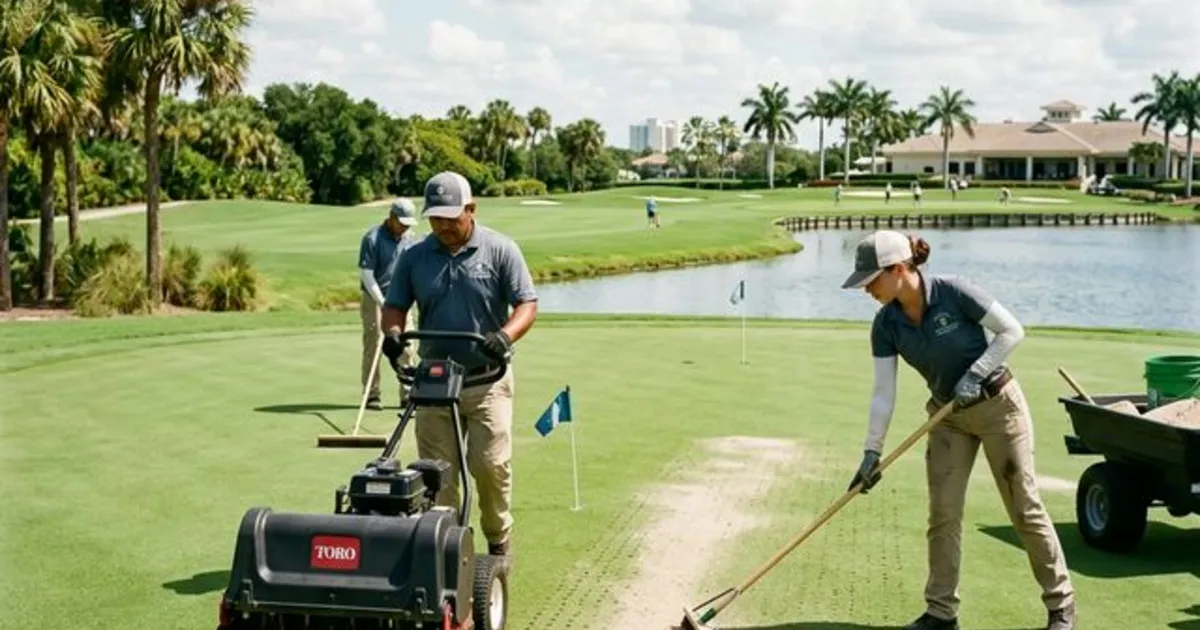
Aerification is the process of punching holes into putting surfaces and fairways to relieve compaction, improve drainage, and allow air and nutrients to reach root systems. It is one of the most well-documented and agronomically important practices in turfgrass management, and it temporarily makes greens nearly unplayable.
During aerification, a machine runs across the green surface pulling out small cores of soil. Those holes are then backfilled with sand, which improves drainage and prevents the organic matter buildup that causes greens to become soft and inconsistent over time.
The USGA Green Section has documented extensively how regular aerification keeps greens firmer, faster, and more consistent across the playing season.
Most SWFL courses aerify greens at least twice a year, once in late spring before the summer slowdown and once in early fall before overseeding. Some courses with heavy play aerify more frequently.
Fairways typically get deep-tine or solid-tine aerification at least once annually, often during the height of summer when cart traffic is lightest.
After aerification, greens need two to four weeks to fully recover depending on temperature, moisture, and how aggressively the turf was disrupted. That recovery window is one reason why courses schedule major maintenance in summer rather than trying to squeeze it into a two-day window between busy weekends in March.
Bermudagrass vs. Ryegrass: The Two-Turf System
If you have played Southwest Florida in January, you have played on overseeded turf. Here is how that works.
Bermudagrass is a warm-season grass that goes dormant when soil temperatures drop below roughly 50 degrees Fahrenheit. In Southwest Florida, soil temperatures do not get that cold, even in January, overnight lows rarely push greens into full dormancy.
But Bermuda does slow down significantly in the cooler months, and its color fades to a tan or light brown that most golfers find unappealing and that can play inconsistently depending on the variety.
The solution is overseeding, broadcasting perennial ryegrass seed over dormant or semi-dormant Bermuda in October or early November so that a second, cool-season grass fills in and provides green color and consistent ball roll through the winter months. The ryegrass germinates quickly in SWFL's mild fall temperatures and grows through the Bermuda canopy, giving courses a lush, consistent playing surface during peak season.
Come spring, rising temperatures kill off the ryegrass and the Bermuda, which has been suppressed but not gone, comes roaring back. This transition period, typically March through May, is called "transition" or "green-up" and it is one of the more challenging stretches for a superintendent.
The ryegrass starts dying in patches, the Bermuda is not yet fully established, and conditions can look rough for several weeks.
Overseeding practices vary by course and surface. Ask the superintendent or golf shop about the actual maintenance plan rather than assuming TPC Treviso Bay and Tiburon overseed every playing area.
"Always a pleasure playing at TPC Treviso. Nice layout and challenging holes with fast greens."
napolidon2012, GolfPass review
The Golf Course Superintendents Association of America provides detailed resources on overseeding timing, seed selection, and transitioning back to Bermuda, all of which vary by region and grass variety.
Irrigation Systems: Summer Is When the Infrastructure Gets Fixed
Modern golf course irrigation systems are sophisticated, hundreds of heads per 18 holes, controlled by computerized central systems that apply precise amounts of water to specific zones based on evapotranspiration data, soil moisture sensors, and weather station input. When a head fails during season, a crew member patches it and moves on.
When the whole system needs attention, that happens in summer.
Off-season irrigation work at SWFL courses can include replacing aging mainlines, upgrading to newer rotary heads that apply water more uniformly, adding or reconfiguring zones to address dry spots that showed up during the previous season, and calibrating the central control system to reduce water use while maintaining turf quality. Some courses coordinate with their water management district on reclaimed water permits and storage capacity during the off-season when the stakes for disruption are lower.
Drainage work often happens alongside irrigation projects. Southwest Florida receives 50 to 60 inches of rain annually, most of it falling between June and September.
Courses that hold water after heavy rains, creating cart path closures and flooded low spots, often address those drainage issues during summer when the ground crew has more time and the course has fewer paying guests.
What Superintendents Are Actually Planning For
The benchmark that drives every off-season maintenance schedule at a SWFL course is a target date, typically sometime in late October or early November, when the course needs to be in peak condition for the first wave of seasonal residents and visitors.
Working backward from that date, a superintendent builds a schedule that looks something like this:
- May, June: Final spring aerification of greens. Begin heavy fairway maintenance including deep-tine aerification. Address any drainage projects that came out of the previous rainy season.
- July, August: Peak summer growing season. Bermuda fills in aggressively. Superintendents manage growth rates, apply fertilizer programs timed to Bermuda's uptake cycle, and complete any construction work on bunkers, tee boxes, or irrigation infrastructure.
- September: Pre-overseeding preparation. Greens and fairways are scalped down to lower the Bermuda canopy and create good seed-to-soil contact for ryegrass. This is one of the most labor-intensive stretches of the year.
- October: Overseeding. Ryegrass seed is broadcast and germination begins within 5 to 7 days under good conditions. Courses often reduce play or close specific holes during germination to protect the seedbed.
- Late October, November: Ryegrass is established, greens are rolling consistently, and the course is ready for peak season.
A temporary closure can reflect aeration, construction, weather or other work. Ask the operator about the reason and available holes; Old Corkscrew's end of daily operations is not a routine seasonal maintenance closure.
Why Courses Close Temporarily, and What It Signals
Temporary closures during the off-season get a bad reputation among golfers who do not understand what is happening on the other side of the gate. A course that closes for a week in October to let overseeded greens establish is making a deliberate trade, short-term lost revenue for significantly better playing conditions through the entire peak season.
The alternative is to keep the course open, take rounds on greens that are still recovering from aerification or overseeding, and end up with damaged, inconsistent surfaces by December. Once traffic damage sets in during ryegrass establishment, it takes the rest of the season to work through.
Cart path only restrictions serve a similar purpose. When the ground crew needs to aerate or when recent rains have saturated the fairways, keeping carts on paths protects both the turf and the drainage infrastructure underneath it.
A few weeks of path-only play in June means dry, firm fairways in January.
If you are playing summer golf in Southwest Florida and run into these conditions, it helps to know what is going on. Our summer golf guide for SWFL covers how to make the most of off-season rounds including what to expect from course conditions and how to find the best deals when seasonal residents are gone.
The Turf Management Details That Separate Good Courses From Great Ones
Beyond the major seasonal practices, the difference between an average course and a well-conditioned one often comes down to the details: how tightly greens are mowed and how frequently, how aggressively the superintendent manages thatch, whether the bunker sand is regularly cultivated to prevent compaction, and how precisely the irrigation system delivers water without over- or under-watering individual zones.
Greens mowing height is one of the more consequential daily decisions a superintendent makes. Mowing too low stresses the grass and leads to thin, disease-prone surfaces.
Mowing too high reduces ball speed and makes putting inconsistent. SWFL Bermuda putting surfaces during peak season are typically mowed at around .125 inches, roughly the thickness of a credit card, which requires extremely precise equipment and daily attention.
Fungicide and pesticide programs are another area where off-season work pays dividends. Summer humidity and heat create ideal conditions for turf diseases like Pythium blight and dollar spot.
Superintendents who stay ahead of disease pressure during the off-season through preventative spray programs and cultural practices like proper mowing and fertility management arrive at peak season with healthier turf that holds up to heavy traffic better.
The USGA Green Section Record is one of the best ongoing resources for understanding how agronomic decisions at the superintendent level translate to what golfers see and feel on the course.
What This Means for You as a Golfer
Understanding what goes into off-season conditioning changes how you read a course. When greens are firm and fast in December, that is not luck, it reflects a superintendent who planned aerification timing correctly and protected the seedbed during ryegrass establishment.
When bunker sand is consistent and raked to a uniform depth, that is the result of regular maintenance that happened quietly during summer rounds with 40 golfers a day instead of 240.
It also helps you interpret course conditions during the off-season more charitably. A course running cart path only in August is not poorly managed, it is actively protecting what will be excellent turf by November. A closed hole in September almost certainly has seed germinating on it.
Southwest Florida golf courses put serious work into the months when most people are not watching. The results show up every November when conditions are right and the season opens on turf that looks and plays exactly the way it should.

Frequently Asked Questions
When do SWFL golf courses typically overseed?
Most Southwest Florida courses overseed greens and fairways in October, with some starting in late September depending on the variety of ryegrass they use and when they need the course ready for peak season. The exact timing varies by course and by how aggressively they want the ryegrass established before the first wave of seasonal traffic.
Why do courses close during overseeding?
Ryegrass seed needs 5 to 10 days to germinate and another two to three weeks to establish enough root depth to handle regular play. Cart traffic or foot traffic on a seedbed during this window can kill germinating seeds, create bare spots, and leave the turf vulnerable to disease.
A short closure protects a full season of playing conditions.
What is aerification and why does it make greens bumpy?
Aerification involves pulling small plugs of soil out of putting surfaces and backfilling those holes with sand. Immediately after aerification, greens have visible holes and feel rough to putt on.
Within two to four weeks, the Bermuda or ryegrass grows back through the sand and the surface smooths out, and the overall health of the green improves significantly because drainage and root-zone airflow are better.
Is Bermudagrass or ryegrass better for Southwest Florida?
They serve different purposes. Bermudagrass is the permanent, heat-tolerant base turf that thrives in SWFL's long, hot summers.
Ryegrass is a temporary cool-season grass overseeded for winter color and consistent ball roll during peak season. Neither is better, they work together as a system, with Bermuda providing the permanent root structure and ryegrass providing the winter playing surface.
How long does it take a golf course to recover after major summer maintenance?
Recovery time depends on what work was done. Greens aerification typically requires two to four weeks of reduced play or full closure.
Overseeding germination and establishment adds another three to four weeks before the surface is ready for full traffic. Courses that sequence these practices correctly, aerifying in May or June and overseeding in October, avoid stacking recovery periods on top of each other and arrive at peak season on schedule.
Why do some courses in Southwest Florida look better than others in the same conditions?
Budget, staffing, and agronomic philosophy all play a role. A course with a well-resourced maintenance department and a superintendent who builds a rigorous off-season program will consistently outperform a course that skips aerification cycles or overseeds too late.
Equipment quality matters too, precise mowing requires well-maintained reel mowers calibrated to tight tolerances. The courses that consistently receive high conditioning marks in Southwest Florida tend to invest heavily in off-season work that most golfers never see directly.
auto_stories Recommended Reading